

 English
 German
 French
 Russian
 Spanish
 Japanese
 Korean
 Portuguese
 Ukrainian
 Arabic
 Italian
 Afrikaans
 Albanian
 Armenian
 Azerbaijani
 Basque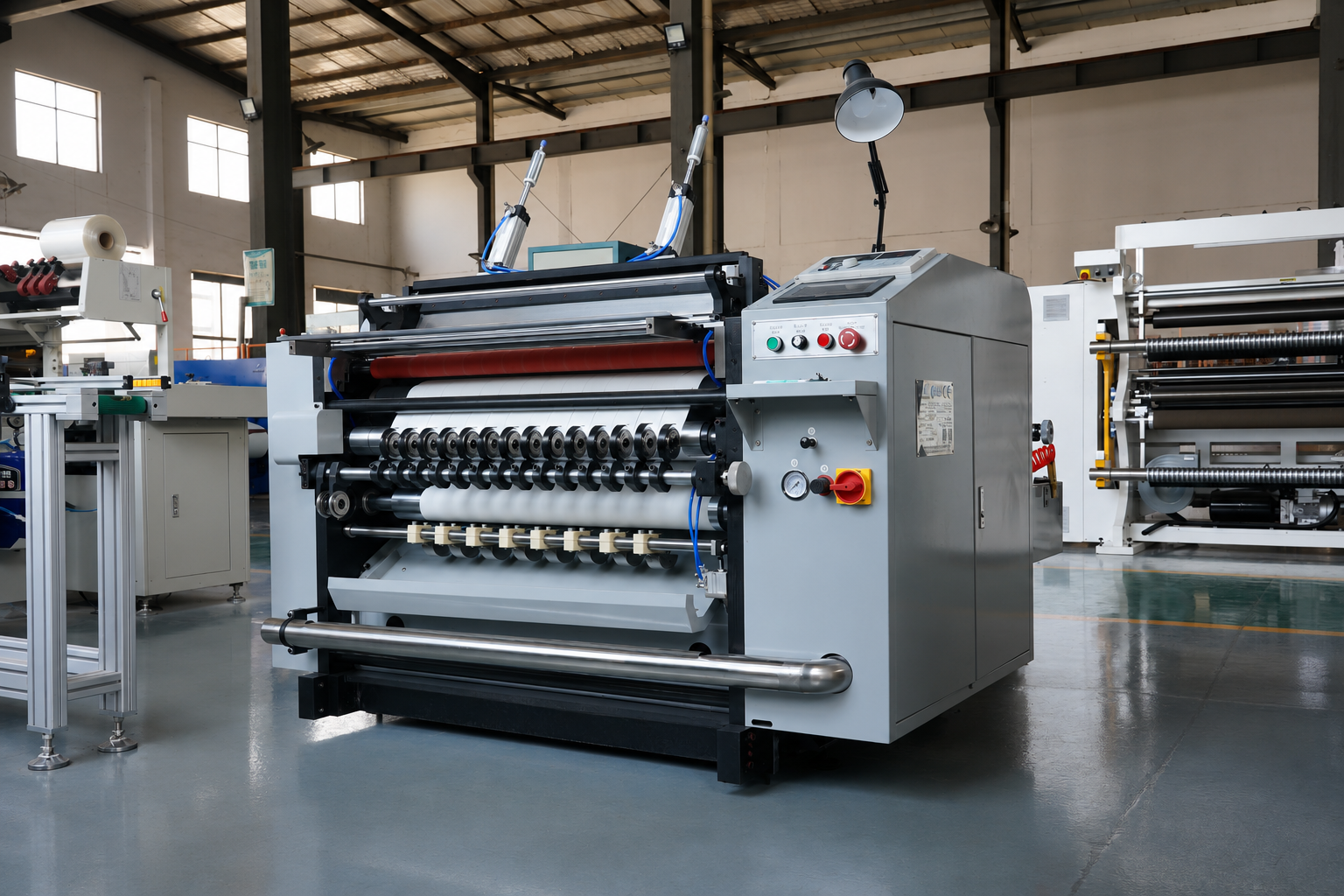
Choosing the right POS paper roll slitting machine is an important decision for converters producing receipt rolls, cash register rolls, ATM paper, queue-ticket rolls, and other small thermal paper products. The machine must do more than cut a jumbo roll into narrow widths. It also needs to maintain stable web handling, produce consistently wound rolls, support practical core and roll formats, and fit the factory’s actual production plan.
A suitable POS paper roll slitter should be selected according to material behavior, parent-roll specifications, finished-roll requirements, automation expectations, and long-term operating costs. This guide explains the main points buyers should evaluate before requesting a machine proposal.
What Is a POS Paper Roll Slitting Machine?
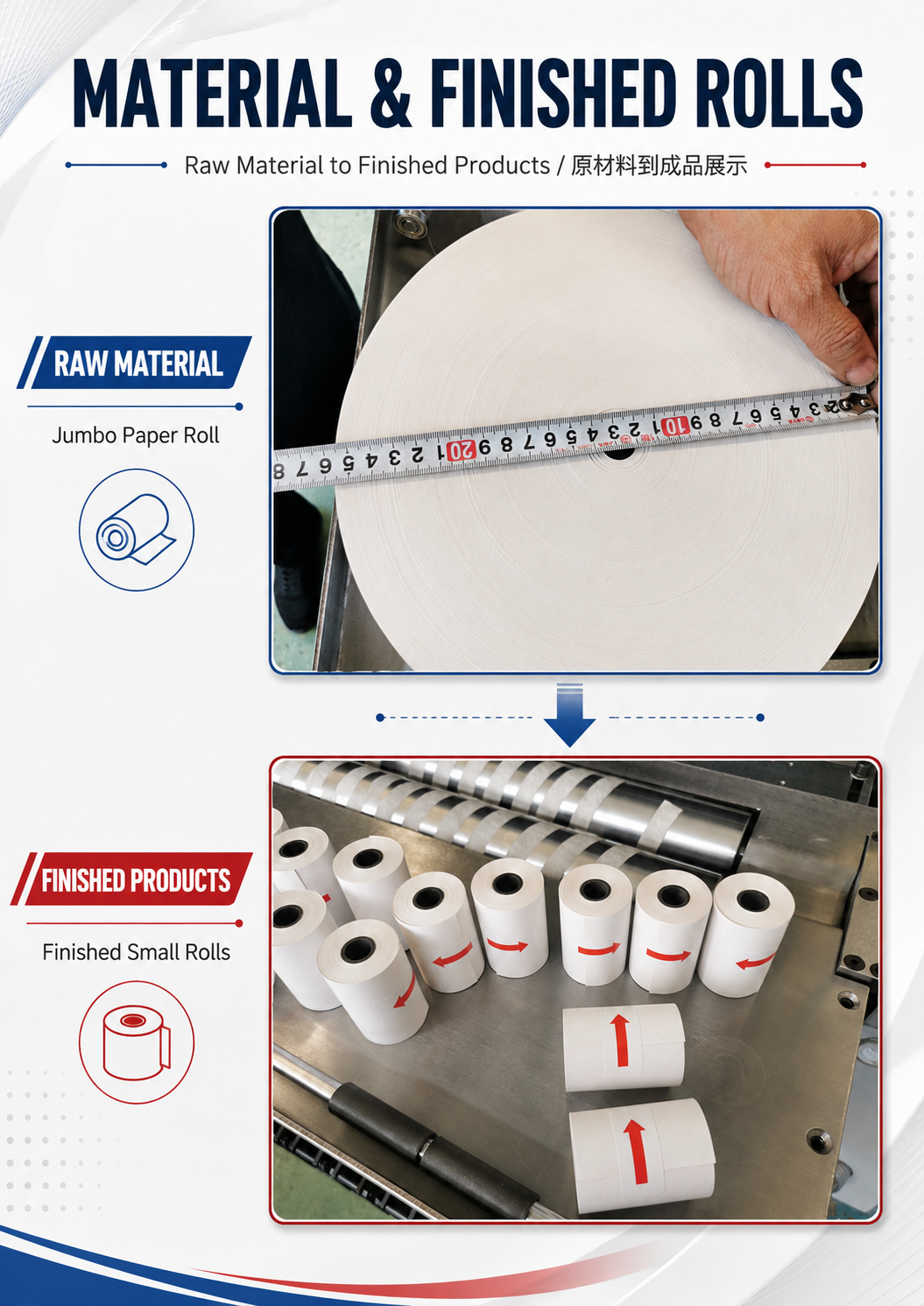
A POS paper roll slitting machine is a converting system used to unwind a wide paper roll, slit the web into multiple narrow strips, and rewind those strips into finished receipt-paper rolls. Depending on the final configuration, the line may also include printing, perforating, automatic roll handling, core loading, packaging preparation, or coreless rewinding functions.
The machine is commonly used for thermal paper and other lightweight paper materials. Its basic sections normally include unwinding, web guiding, tension control, slitting, rewinding, and finished-roll handling. The exact structure should be matched to the required roll size and production process rather than selected only by maximum speed.
Why POS Paper Roll Production Needs Stable Slitting and Rewinding
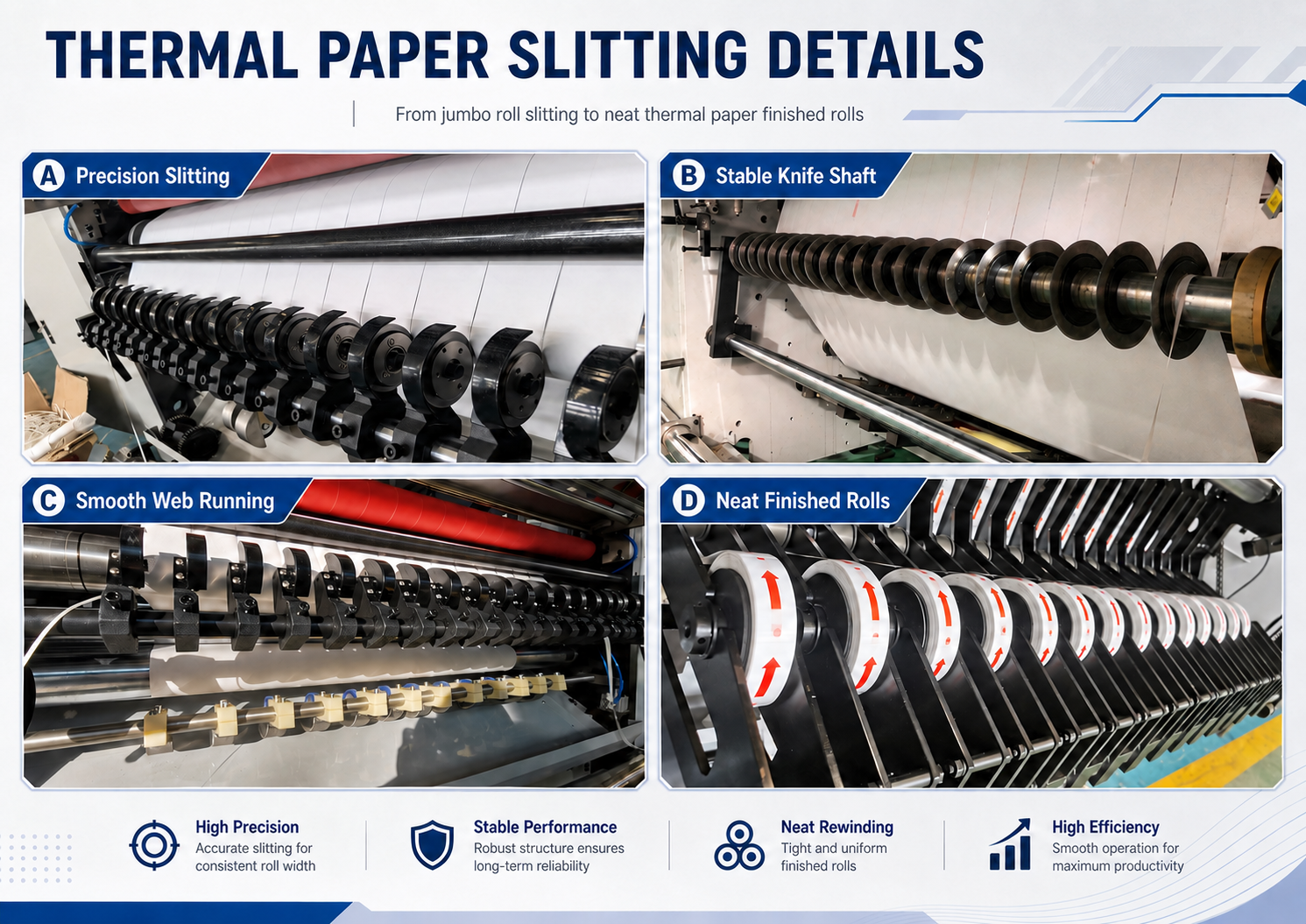
POS rolls are small finished products, so minor web-handling problems can become visible across a large number of rolls. Uneven tension may cause telescoping, loose winding, wrinkles, or inconsistent roll hardness. Poor slit quality may create dust, rough edges, width variation, or downstream printing and feeding problems.
Stable unwinding and rewinding are therefore central to reliable production. A well-configured thermal paper slitting machine should keep the paper path controlled from the parent roll to the finished rolls. The goal is not simply high output, but repeatable roll quality, manageable waste, practical operator work, and smooth production changes.
Key Machine Sections and Features to Evaluate
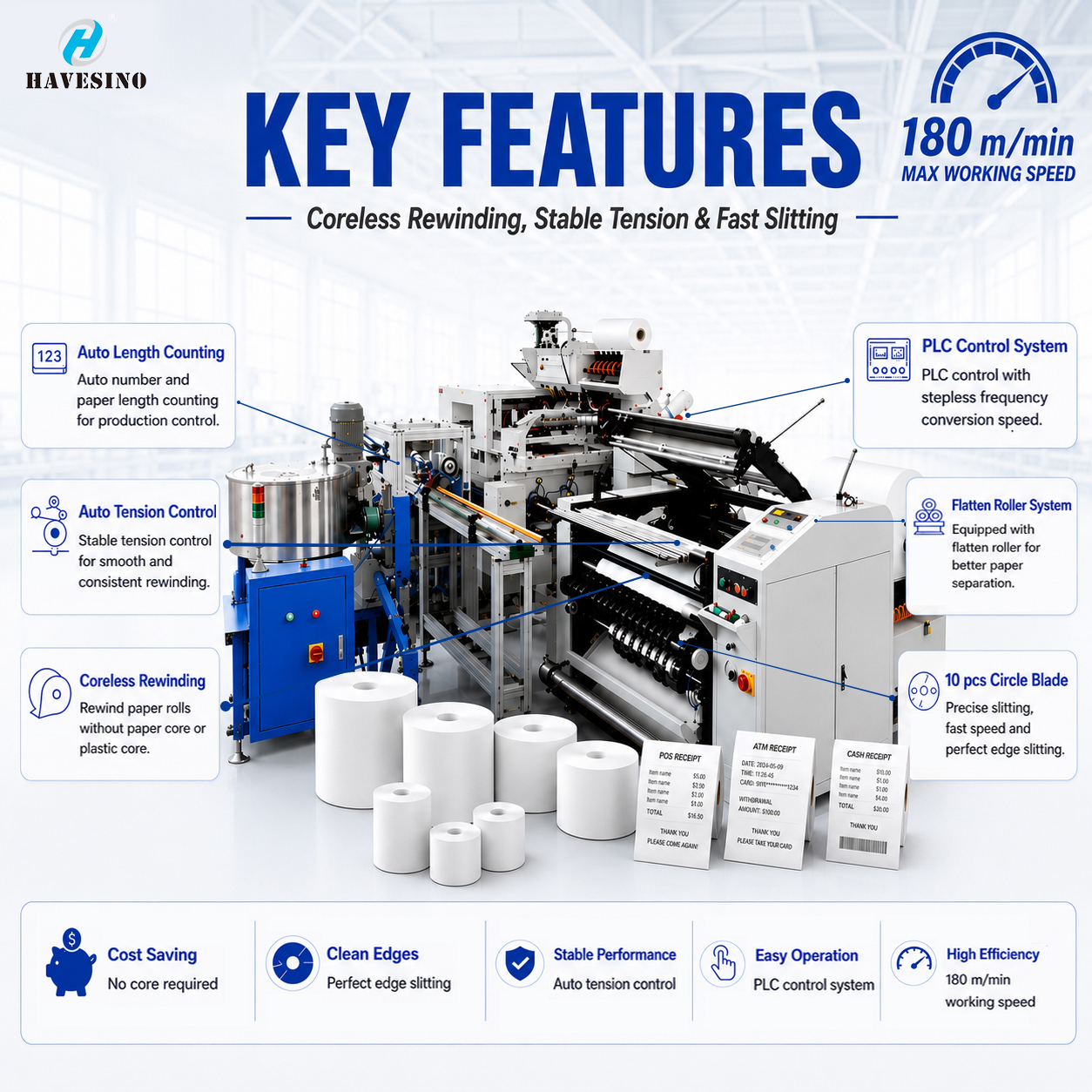
When comparing a POS paper roll slitting machine, buyers should examine the complete converting process instead of focusing on one specification. The following areas deserve particular attention:
Machine Area | What to Evaluate | Why It Matters |
Unwinding section | Parent-roll loading method, shaft or shaftless design, braking, and web stability | Supports safe loading and controlled paper feeding |
Web guiding | Edge or line guiding method and correction response | Helps maintain slit position and finished-roll consistency |
Tension control | Control method across acceleration, steady running, and deceleration | Reduces wrinkles, loose rolls, and winding variation |
Slitting system | Knife type, adjustment method, dust control, and maintenance access | Influences slit-edge cleanliness and changeover efficiency |
Rewinding section | Core handling, shaft arrangement, roll separation, and winding control | Determines finished-roll shape, hardness, and operator workload |
Automation | Automatic core loading, roll pushing, sealing, conveying, or packaging interfaces | Can reduce repetitive labor and improve production flow |
Controls and safety | Operator interface, fault indication, guarding, emergency stops, and service access | Supports practical daily operation and maintenance |
How to Choose the Right POS Paper Roll Slitter
1. Define the Paper Material Clearly
Start with the actual paper grade. Thermal paper can vary in basis weight, coating, surface sensitivity, stiffness, and dust behavior. Share representative samples or detailed material information with the machine manufacturer. This helps determine suitable web handling, slitting, tension, and cleaning arrangements.
2. Confirm Parent-Roll and Finished-Roll Specifications
Prepare the parent-roll width, maximum roll diameter, core size, and roll weight. For finished rolls, specify roll width, roll diameter or length, core type, core inner diameter, and acceptable winding appearance. Buyers producing several roll formats should also explain the expected product mix and changeover frequency.
3. Match Capacity to Realistic Production Demand
Higher nominal speed does not automatically mean higher usable output. Actual productivity also depends on loading time, core preparation, roll removal, product changes, packaging flow, and operator availability. A practical capacity calculation should include the whole production cycle.
4. Decide the Required Automation Level
Manual, semi-automatic, and automatic systems serve different business models. A growing converter may prioritize flexibility and manageable investment, while a high-volume producer may need automatic core handling, finished-roll discharge, and integration with packing equipment. Automation should solve a real labor or throughput constraint.
5. Consider Core and Coreless Products
Some markets require conventional cored POS rolls, while others use coreless thermal paper rolls. These products involve different rewinding and finished-roll handling requirements. Confirm whether one machine configuration can cover the planned formats or whether a dedicated coreless thermal paper slitter is more appropriate.
6. Check Printing and Additional Converting Needs
If the product requires logos, advertising, marks, or other printed content, an inline flexographic printing configuration may be considered. Printing requirements should be defined early because they affect web path, drying, registration, space, and production workflow.
7. Evaluate Maintenance and Technical Support
Ask how knives, shafts, bearings, sensors, and other service parts are accessed and replaced. Also confirm training, manuals, remote troubleshooting, spare-parts support, and pre-shipment testing procedures. Reliable technical support is important because a POS paper roll slitter is a long-term production asset.
Recommended HAVESINO Solution
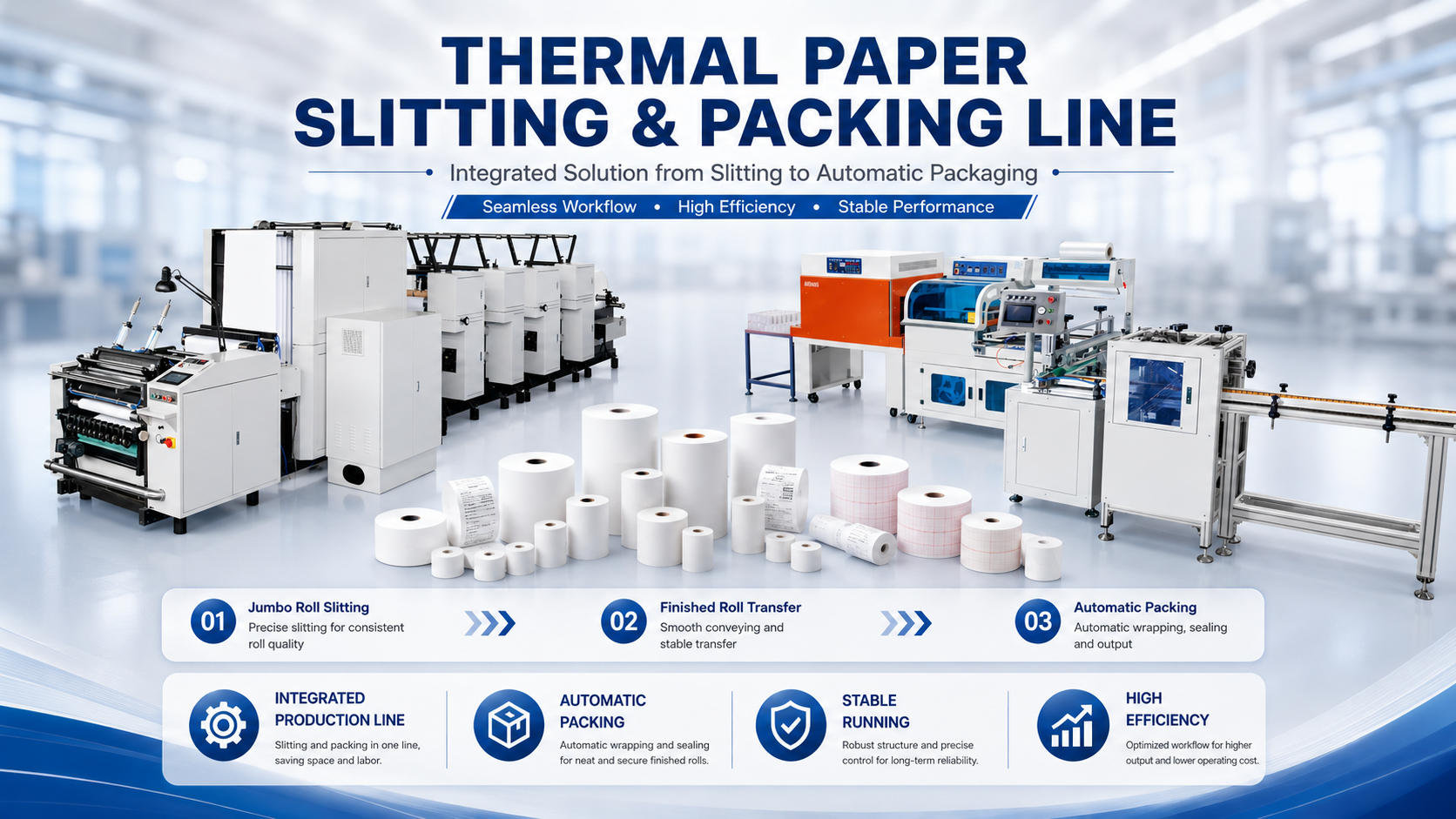
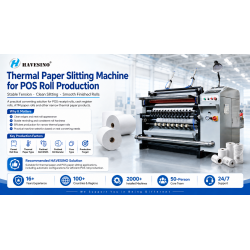
HAVESINO provides POS and thermal paper converting solutions that can be configured according to actual roll size, material type, finished-roll format, automation target, and factory workflow.
For fully automatic production, the CP-S1100FA automatic paper roll slitting machine can be considered based on the required configuration. For projects involving inline printing, CP-S1100AC/CC configurations may be evaluated. Coreless roll applications can be discussed using solutions such as the CP-S1200CW or CP-S900CW, depending on production requirements.
Machine selection should begin with a clear product specification rather than a model name alone. HAVESINO can review the buyer’s paper sample, parent-roll data, finished-roll dimensions, core format, target capacity, and packing process before recommending a suitable POS paper roll slitting machine.
Common Problems and Practical Considerations
- Loose or uneven finished rolls: Review tension settings, rewinding control, paper variation, and roll-removal timing.
- Paper dust around slit edges: Evaluate knife condition, knife selection, blade setup, extraction, and cleaning routines.
- Width inconsistency: Check web guiding, knife positioning, shaft condition, and parent-roll alignment.
- Frequent production stops: Examine loading, core preparation, finished-roll discharge, and packing bottlenecks rather than machine running speed alone.
- Wrinkles or web wandering: Confirm parent-roll quality, web path alignment, tension control, and guiding response.
- Long changeovers: Organize product recipes, knife-setting procedures, core preparation, and operator training.
Information to Provide Before Requesting a Quotation
A precise inquiry helps the manufacturer recommend the correct structure and avoid unnecessary options. Buyers should provide:
- Paper type and sample, when available
- Parent-roll width, diameter, core size, and weight
- Finished-roll width, diameter or length, and core specification
- Number of slit rolls or slit widths per production setup
- Required cored or coreless product format
- Printing, perforating, sealing, or packaging requirements
- Expected daily or monthly output
- Preferred automation level and available operators
- Factory power conditions and available floor space
FAQ
What materials can a POS paper roll slitting machine process?
It is mainly used for thermal paper and related lightweight paper materials. The suitable configuration depends on the paper grade, coating, thickness, parent-roll size, and finished product.
Is higher machine speed always better for POS roll production?
No. Usable output depends on the full cycle, including roll loading, core handling, slitting, rewinding, roll removal, product changes, and packing. Stable production at a practical speed is often more valuable than a high nominal speed.
Can one machine produce different POS roll widths?
In many cases, yes. Knife positions, rewinding arrangements, cores, and machine configuration can be adapted for different widths. The expected product range should be confirmed before ordering.
Can the machine produce coreless thermal paper rolls?
Coreless production requires a suitable rewinding and roll-handling structure. Buyers should specify coreless requirements at the quotation stage so the manufacturer can recommend an appropriate configuration.
What information should buyers send to the machine supplier?
Send the paper type, parent-roll width and diameter, finished-roll width and diameter or length, core details, target capacity, automation preference, and any printing or packing requirements.
How should a buyer compare different machine quotations?
Compare the complete scope, including unwinding, guiding, tension control, slitting, rewinding, automation, safety, testing, spare parts, training, and technical support. Avoid comparing only price or maximum running speed.
Conclusion
The right POS paper roll slitting machine should match the material, parent-roll size, finished-roll format, capacity target, operator arrangement, and future product plan. Stable tension, clean slitting, smooth rewinding, practical automation, and reliable support are more important than selecting a machine from one headline specification.
Share your paper type, parent-roll size, finished-roll specifications, core format, and production target with HAVESINO to discuss a suitable POS paper roll slitting machine configuration.


Leave A Comment