

 English
 German
 French
 Russian
 Spanish
 Japanese
 Korean
 Portuguese
 Ukrainian
 Arabic
 Italian
 Afrikaans
 Albanian
 Armenian
 Azerbaijani
 Basque
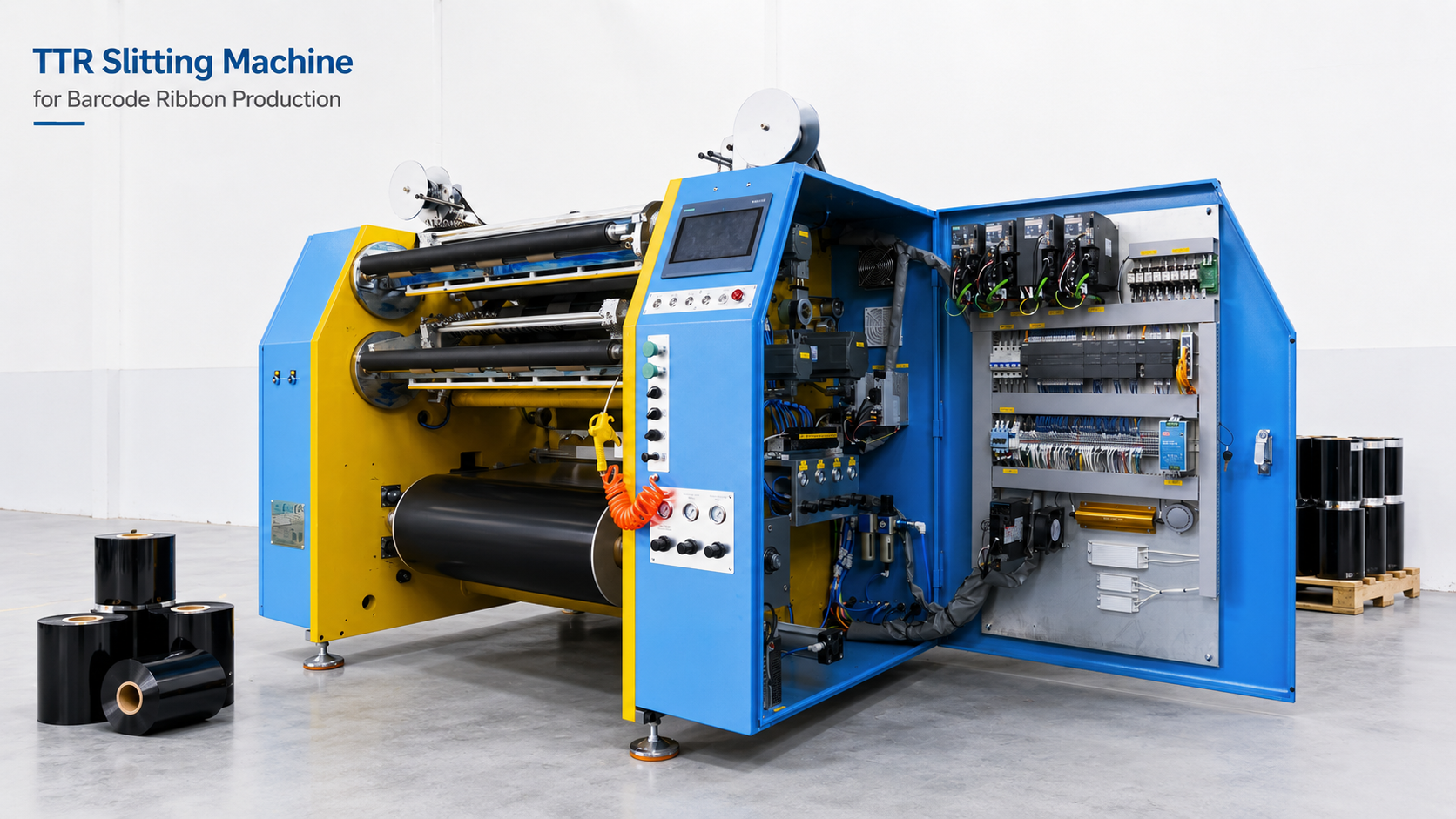 A TTR slitting machine is an important production machine for converting thermal transfer ribbon jumbo rolls into finished barcode ribbon rolls. For ribbon manufacturers and converters, the key is not only to cut the material into the required width, but also to keep stable tension, clean slit edges and smooth finished rolls during continuous production.
Barcode ribbon production often involves wax, wax-resin and resin ribbons used for labels, logistics, retail, packaging, electronics and industrial identification. Because these ribbons are thin, coated and sensitive to winding quality, the slitting and rewinding process must be controlled carefully. A reliable barcode ribbon slitter helps reduce roll defects, improve consistency and support efficient order delivery.
HAVESINO Group provides professional slitting and rewinding solutions for flexible packaging, label, TTR, foil and paper roll applications. For TTR production, HAVESINO focuses on stable tension control, clean slitting performance, practical automation and smooth rewinding, helping customers build a more reliable barcode ribbon converting process.
What Is a TTR Slitting Machine?
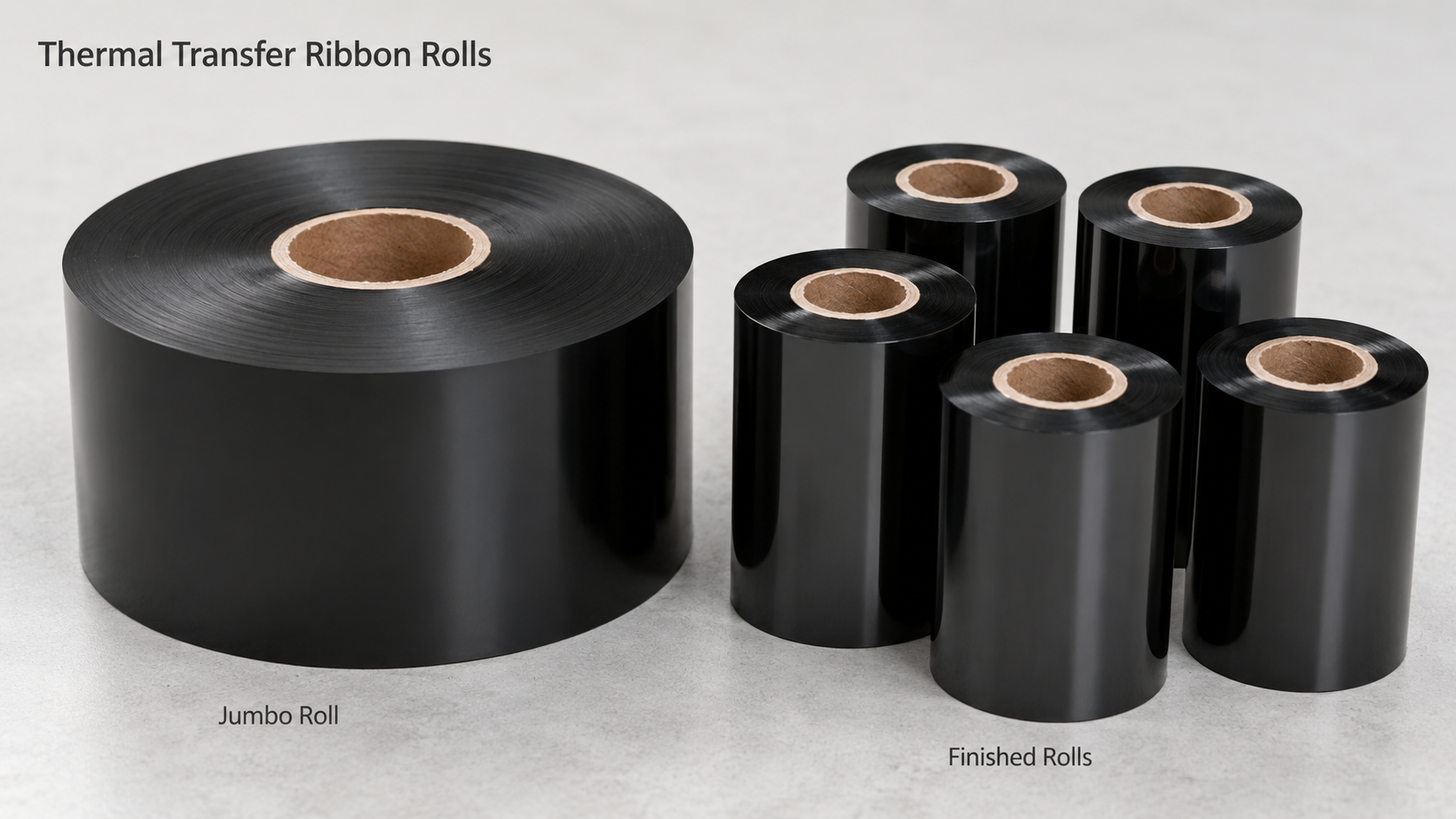
A TTR slitting machine is used to slit thermal transfer ribbon jumbo rolls into narrower finished rolls according to customer specifications. The process normally includes unwinding, web guiding, tension control, slitting, rewinding and finished roll unloading. The final roll may be used in desktop printers, industrial barcode printers, label printing systems or packaging identification equipment.
Unlike ordinary film slitting, thermal transfer ribbon slitting requires careful handling of coated ribbon surfaces and sensitive winding structures. The machine needs to keep the ribbon running flat, control tension changes and avoid edge damage during high-volume production.
Why Barcode Ribbon Production Needs Stable TTR Slitting
Barcode ribbon rolls must run smoothly in printers. If the finished roll has poor winding, uneven tension, telescoping, wrinkles or damaged edges, customers may face printing breaks, poor barcode quality or unstable printer operation. This is why the slitting process directly affects the usable quality of the ribbon.
Different ribbon formulas may behave differently during converting. Wax ribbon is commonly used for general label printing, while wax-resin and resin ribbons often require better durability and more careful processing. A suitable thermal transfer ribbon slitter should support stable unwinding and rewinding based on the actual material type, roll width, core size and finished roll requirements.
Key Sections of a Barcode Ribbon Slitter
A professional barcode ribbon slitter is usually designed around several core machine sections. Each section affects production stability and finished roll quality.
Machine Section | Main Function | Why It Matters for Barcode Ribbon |
Unwinding section | Holds and releases the jumbo roll | Stable unwinding helps avoid web shaking and tension fluctuation. |
Web guiding system | Keeps the ribbon aligned during running | Accurate tracking supports consistent roll width and cleaner rewinding. |
Tension control system | Controls web tension from unwind to rewind | Stable tension helps reduce wrinkles, telescoping and uneven rolls. |
Slitting section | Cuts the ribbon into required widths | Clean slitting helps protect ribbon edges and printing performance. |
Rewinding shafts | Rewinds finished rolls onto cores | Smooth rewinding supports better roll appearance and printer compatibility. |
Control system | Manages operation, settings and production flow | Practical controls help operators run different ribbon jobs more efficiently. |
Common Problems in TTR Ribbon Slitting
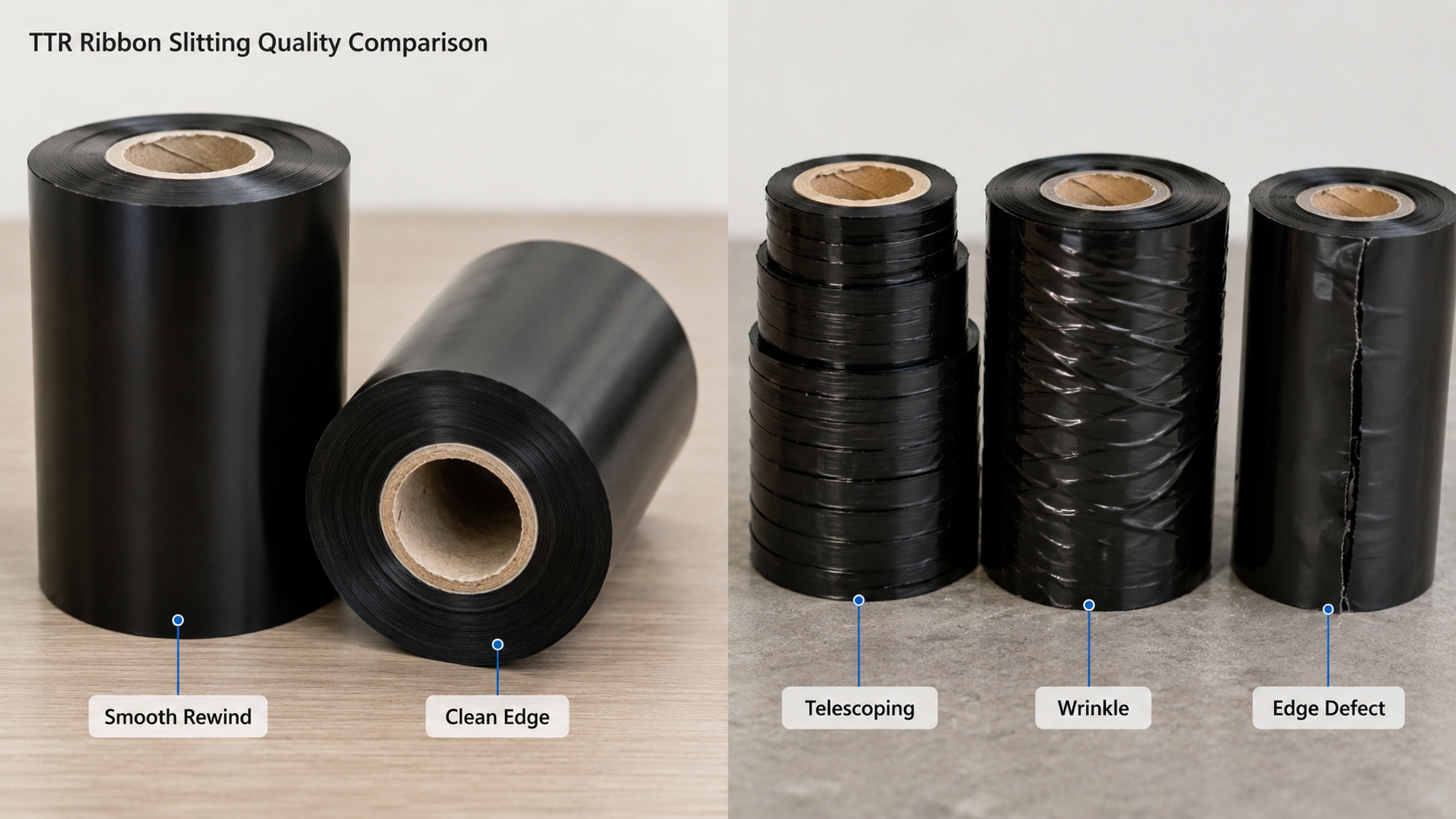
In barcode ribbon production, many quality issues are related to tension, blade condition, winding pressure or material matching. Common problems include edge burrs, uneven roll hardness, wrinkles, poor alignment, telescoping rolls and unstable roll appearance.
These issues are not always caused by one single factor. The operator may need to check the ribbon formula, jumbo roll quality, slitting method, blade setup, rewinding pressure, core condition and machine configuration. A well-designed TTR slitting machine makes this adjustment process easier and more repeatable.
How to Choose a TTR Slitting Machine for Barcode Ribbon
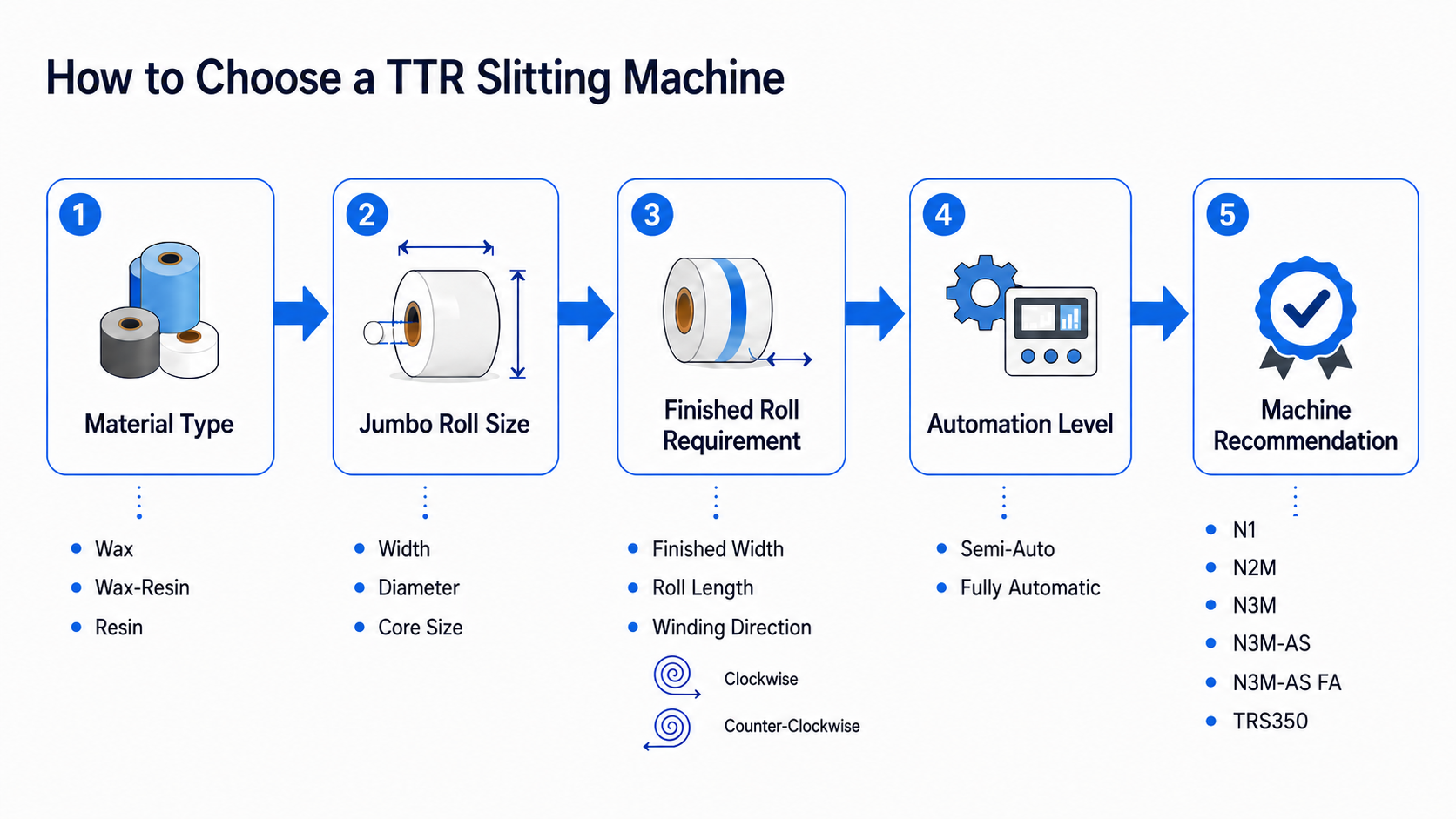
When selecting a TTR slitting machine, buyers should first clarify the real production requirements instead of only comparing machine appearance. A suitable configuration depends on the material, roll size, production target and automation level required by the factory.
Before asking for a machine recommendation, it is helpful to prepare the following information:
- Ribbon type: wax, wax-resin, resin or other coated ribbon material.
- Jumbo roll width, roll diameter and core size.
- Finished roll width, length, diameter and core specification.
- Required winding direction and printer application.
- Expected production capacity and operator arrangement.
- Need for manual, semi-automatic or fully automatic operation.
- Special requirements for ribbon saving, inspection, labeling or packaging connection.
For many factories, higher speed is not the only target. Stable running, repeatable quality and easy job changeover may be more important in daily barcode ribbon production. The right machine should match the customer’s order structure and operator experience.
Recommended HAVESINO Solution for TTR Slitting
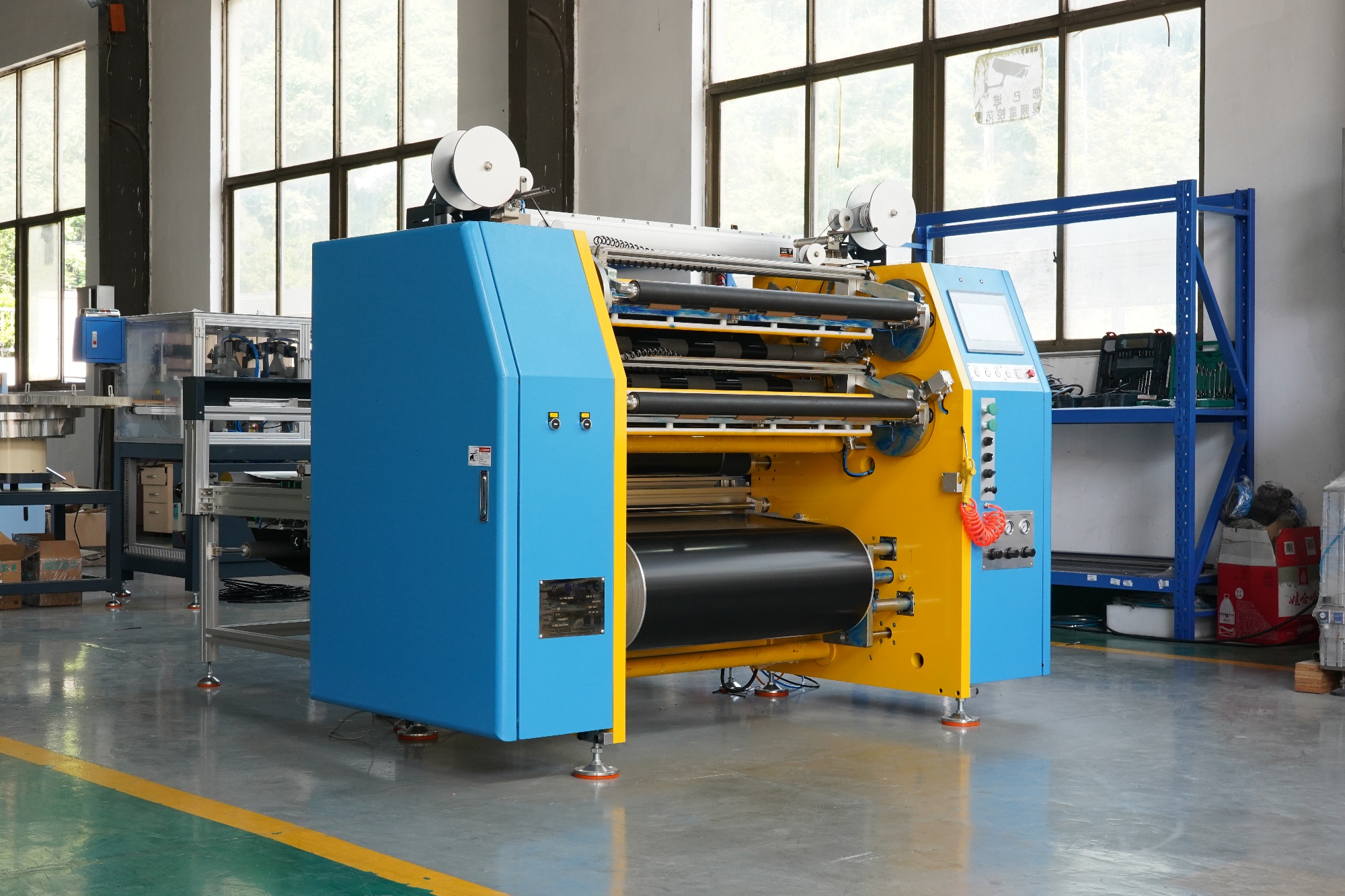
HAVESINO can recommend different TTR slitting solutions according to actual ribbon type, roll size and production needs. For customers looking for a professional TTR slitting machine for barcode ribbon production, HAVESINO solutions focus on stable tension, clean edge slitting, smooth finished rolls and practical operation.
For TTR applications, machines such as the N2M TTR slitter or the fully automatic TTR slitter rewinder N3M-AS can be considered depending on the final configuration and automation requirements. When customers need a more advanced production flow, an automatic TTR slitting solution can help reduce manual handling and improve production consistency.
As a slitter rewinder manufacturer with 16+ years of industry experience, HAVESINO Group serves customers in more than 100 countries and regions with over 2,000 installed machines. The company’s focus is to provide reliable converting equipment and practical technical support for different materials and production environments.
Practical Considerations Before Production
Before starting mass production, ribbon converters should test the machine with real materials whenever possible. Trial running helps confirm slitting quality, winding stability, operator settings and finished roll appearance. It also helps both the supplier and the customer understand whether the selected configuration matches the actual production target.
Maintenance is also important. Operators should check blade condition, clean dust or coating residue, confirm core quality and monitor winding pressure regularly. Good daily operation habits can help keep the TTR slitter rewinder running more smoothly over time.
FAQ
What is a TTR slitting machine used for?
A TTR slitting machine is used to convert thermal transfer ribbon jumbo rolls into narrower barcode ribbon rolls for label printers, barcode printers and related printing applications.
What materials can a barcode ribbon slitter process?
A barcode ribbon slitter is commonly used for wax, wax-resin and resin thermal transfer ribbons. The final configuration should be selected according to the actual ribbon structure and production requirements.
Is higher speed always better for TTR slitting?
Not always. For barcode ribbon production, stable tension, clean cutting and smooth rewinding are often more important than speed alone. The machine should match the material and finished roll quality requirements.
Can one TTR slitter handle different ribbon widths?
In many cases, one machine can be configured for different finished roll widths, but the actual range depends on the machine design, slitting setup, core specification and production needs.
What information should buyers provide before choosing a machine?
Buyers should provide ribbon type, jumbo roll width, roll diameter, finished roll width, core size, winding direction, production target and automation requirements. This helps HAVESINO recommend a suitable TTR slitter rewinder configuration.
Conclusion
A TTR slitting machine plays a key role in barcode ribbon production because it affects slitting accuracy, roll appearance, printer compatibility and daily production efficiency. For ribbon converters, choosing a reliable barcode ribbon slitter is not only about cutting material into narrow rolls, but also about building a stable and repeatable converting process.
HAVESINO provides practical thermal transfer ribbon slitter solutions for different TTR production needs. Share your ribbon type, jumbo roll size, finished roll requirements and production target, or Contact HAVESINO to discuss a suitable TTR slitting machine configuration.



Leave A Comment