

 English
 German
 French
 Russian
 Spanish
 Japanese
 Korean
 Portuguese
 Ukrainian
 Arabic
 Italian
 Afrikaans
 Albanian
 Armenian
 Azerbaijani
 Basque
What Features Ensure Clean, Dust-Free Slitting of Laminated and Coated Packaging Films?
Ask any converter who runs laminated or coated packaging film and they will tell you the same thing: the cut edge is where quality is won or lost. A slit that looks perfect on the machine can turn into a roll full of dust, coating pick-off and edge debris by the time it reaches the customer. For technical teams specifying a slitter rewinder, understanding which machine features actually prevent that debris is the difference between a stable process and a permanent firefight.
This guide breaks down the machine-level features that keep laminated and coated films clean during slitting, and explains how the HAVESINO HN1300 PLUS flexible packaging slitter rewinder is engineered around them.
Why coated and laminated films generate dust so easily
Before looking at solutions, it helps to be precise about the problem. Dust and edge debris in laminated or coated film usually come from four sources:
- Multi-layer construction. A laminate is a sandwich of substrates bonded by adhesive. If the cutting action is not clean through the full thickness, the layers can separate or fracture at the edge instead of shearing evenly, releasing fine particles.
- Coating and adhesive layers. Functional coatings and adhesive layers are often softer than the carrier film. A cutting geometry that works well on plain BOPP can smear or tear a coated surface, and smeared adhesive becomes a dust magnet downstream.
- Tension variation. Fluctuating web tension changes the actual cutting angle and the load on the blade from one minute to the next. The result is an inconsistent edge: clean in places, rough in others, with loose debris along the rough sections.
- Mechanical vibration and poor material contact. Any movement between the web and the slitting station during the cut introduces chatter. Chatter does not cut; it tears, and tearing is what creates dust.
Environmental factors such as ambient dust and static charge can make an existing problem worse, but they rarely create it. In most cases, the root cause sits in the slitting station itself: how the material is held, how the tension is controlled, and how the blade meets the web.
Feature 1: A slitting method that matches the material
The single most important design decision is whether the machine supports more than one slitting method. Razor slitting and shear-cut slitting do not behave the same way on coated or laminated substrates, and a converter who runs both thin films and thick laminates will eventually need both.
The HN1300 PLUS supports both razor slitting and shear-cut slitting, which allows a smooth transition from thin films to thicker laminated materials without moving the job to a different machine. This flexibility matters for dust control because the correct cutting geometry for a given construction produces a clean shear instead of a tear. When the method matches the material, the edge stays closed and no loose particles are released.
Feature 2: Intelligent tension control
Tension control is the quiet workhorse of clean slitting. If tension drifts, the web position at the blade drifts with it, and the cut quality drifts too.
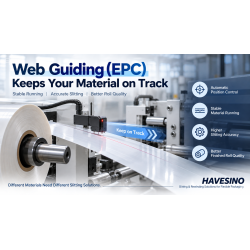
The HN1300 PLUS uses advanced intelligent tension control to maintain stable web handling during high-speed operation. In practice this delivers three benefits that directly affect dust generation:
- Consistent blade contact, so every metre of the web is cut under the same conditions.
- Improved slitting accuracy, which reduces edge variation and the loose debris that comes with it.
- Better rewinding quality and finished roll integrity, so slit edges are not disturbed again during winding.
For coated and laminated films, this stability is what prevents the intermittent rough edges that show up as dust on the finished roll.
Feature 3: The Horizontal Press System
Material contact is the most underrated variable in slitting quality. If the web is not held consistently against the slitting station, the blade effectively works on a moving target.
The HN1300 PLUS is engineered with a specialised horizontal pressing structure that provides more uniform material contact. Compared with standard vertical slitters, this enhances tension consistency, roll tightness and final roll finishing. For laminated and coated packaging films, the practical effect is fewer edge defects, tighter and more uniform rolls, and a much lower chance of coating damage or edge dust appearing anywhere in the finished reel.
Feature 4: A robust mechanical structure
Dust-free slitting is not a one-off achievement, it is a condition that has to hold for the whole shift. That depends on the machine holding its geometry over time.
The HN1300 PLUS is built on a robust mechanical structure that supports long-term operational stability and efficient job changeovers. A stable frame means stable cutting geometry, and stable cutting geometry means the clean edge you set up at the start of the run is still there at the end of it.
The features at a glance
| Feature | What it does | Why it matters for coated and laminated film |
|---|---|---|
| Razor and shear-cut slitting methods | Supports both slitting methods in one machine | Lets the cutting geometry match the construction, so the edge shears cleanly instead of tearing |
| Intelligent tension control | Maintains stable web handling at high speed | Keeps blade contact and edge quality consistent across the full roll |
| Horizontal Press System | Specialised horizontal pressing structure for more uniform material contact | Improves tension consistency, roll tightness and final roll finishing |
| Robust mechanical structure | Stable platform with efficient job changeovers | Keeps cutting geometry stable over long production runs |
| Ultra-wide material range | Handles ultra-thin films, plastic films, printed films, thick laminates and label materials | One platform for the mixed substrate schedules typical of flexible packaging and label work |
Material notes for technical teams
The HN1300 PLUS is designed for flexible packaging films, printed films, laminated materials and label substrates, and delivers stable performance on BOPP, PE, PET, laminated films and complex flexible packaging substrates.
- BOPP and PE. Thin, extensible films where tension stability is the dominant factor in edge quality.
- PET. Higher modulus films where blade geometry and consistent contact determine whether the edge is clean or chipped.
- Laminated and thick laminate structures. Multi-layer builds where the transition between thin films and thicker laminates must be handled without changing the machine setup.
- Printed films and label materials. Surfaces where any edge debris or coating pick-off becomes a visible defect in the finished product.
Where surface coatings or adhesive layers are involved, always confirm the exact construction with the machine supplier before specifying. The right combination of slitting method, tension profile and pressing pressure is material-specific, and it should be validated on your own samples.
What to ask before you specify a slitter
- Which slitting methods do you need today, and which substrates are on your three-year roadmap?
- What is the thinnest and the thickest material in the mix, including laminates?
- How much of your output is coated, adhesive-bearing or printed, where edge debris is a reject risk?
- What finished roll tightness and edge quality does your customer actually inspect?
- How often do you change jobs, and how much downtime does each changeover cost you?
- Are you running at high speed for long runs, where tension stability becomes critical?
Answering these six questions gives you a clear specification, and it gives your supplier a clear basis for recommending a configuration rather than a generic catalogue model.
Where HAVESINO fits
HAVESINO has been a professional producer of slitter rewinders and converting machinery for the packing and label industry worldwide for over 15 years. The HN1300 PLUS is purpose-built for professional converters who require stable slitting accuracy, high-speed operation and excellent roll finishing.
If your problem is edge dust, coating pick-off or inconsistent slit quality on laminated and coated packaging films, our engineering team can review your material structure and production requirements and advise on the right slitting configuration.
Talk to our engineers
- Email: [email protected]
- Telephone: +86-571-56133636
- Address: 509 Room, Xixi Times Center, NO.118 Liuxia Street, Xihu District, Hangzhou, Zhejiang
- Product page: HN1300 PLUS Slitting Machine for Flexible Packaging Material
Send us your film structure, slit width range and target roll specification, and we will tell you which configuration delivers the cleanest edge for your application.
.jpg?x-oss-process=image/resize,m_pad,h_250,w_250)


Leave A Comment