

 English
 German
 French
 Russian
 Spanish
 Japanese
 Korean
 Portuguese
 Ukrainian
 Arabic
 Italian
 Afrikaans
 Albanian
 Armenian
 Azerbaijani
 Basque
Direct answer: Center winding drives the finished roll through the rewind shaft or core, while surface winding drives the roll from its outer surface through contact with a driven drum or belt. Center winding is often the first choice for thin films and applications that need flexible tension control with limited surface pressure. Surface winding is often preferred for thicker, less extensible webs, large-diameter rolls, or applications where controlled surface contact helps build the required roll structure. The best choice depends on material behavior, finished-roll diameter, slit width, roll hardness target, sensitivity to nip pressure and production speed—not on machine speed alone.
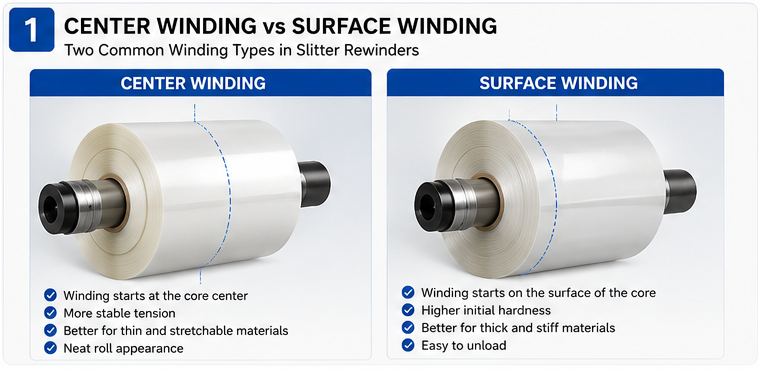
For flexible packaging converters, this distinction matters because the rewinding method directly affects how tension, nip and torque are applied while the roll diameter increases. A machine can slit accurately and still produce poor finished rolls if the winding principle does not match the material.
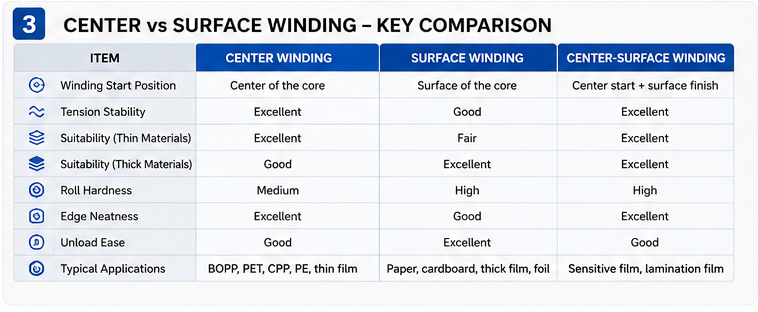
Quick Comparison: Center Winding vs Surface Winding
Factor | Center Winding | Surface Winding |
How the roll is driven | Torque is applied through the rewind shaft/core | The roll is driven by contact with a drum, roller or belt |
Main control influence | Rewind torque / web tension, often with a lay-on or pressure roll | Surface traction and nip/contact pressure, together with incoming web tension |
Typical starting point | Thin films, sensitive surfaces, small-to-medium finished rolls | Thicker or less extensible webs, large rolls, paper/board and some narrow-width applications |
Surface contact | Can be gap wound or contact wound depending on design | Continuous surface contact is fundamental to the winding principle |
Roll hardness control | Strongly influenced by winding tension and torque taper | Strongly influenced by nip/contact and surface drive conditions |
Machine complexity | Often simpler | Usually requires a driven winding drum/contact system |
Do not choose only by | Material name or maximum speed | Material name or maximum diameter |
Important: These are starting points, not universal rules. Roll winding is highly application-specific. Material thickness, modulus, friction, coating, printing, lamination, finished-roll diameter and downstream use can change the best recommendation.
What Is Center Winding?
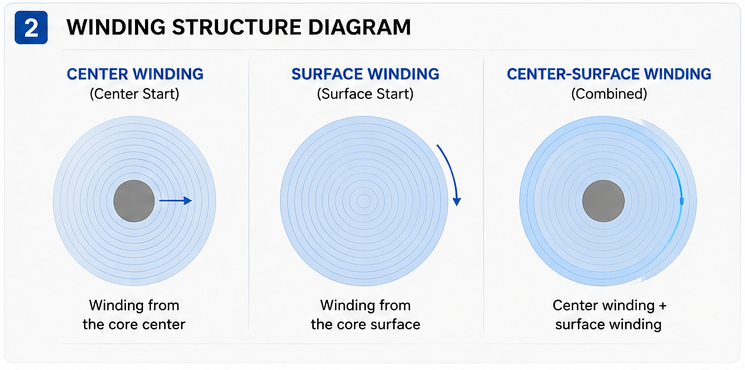
In center winding, the rewind shaft or core is directly driven. Motor torque is transmitted through the core and the layers already wound onto the roll. As the roll diameter grows, the control system adjusts torque and/or tension so the roll does not become excessively tight, loose or unstable.
A center winder can run with a gap between the finished roll and a lay-on roller, or it can use a controlled-contact pressure roll. This gives the machine builder more freedom to manage entrained air, roll hardness and surface pressure according to the material.
When Center Winding Is Usually a Strong Starting Point
- Thin plastic films such as BOPP, PET, PE and other flexible packaging webs.
- Materials where excessive surface pressure could mark, block, scratch or distort the web.
- Applications where the converter wants direct torque control through the rewind shaft.
- High-speed film slitting where stable tension and controlled roll build are critical.
- Small-to-medium rewind diameters where shaft-driven winding is practical and efficient.
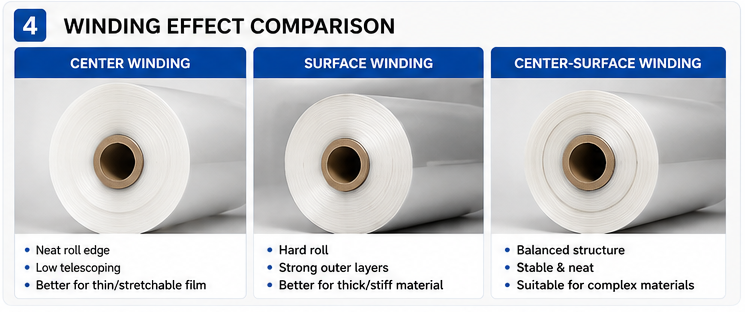
For film converters, center winding is common because the machine can control winding torque as roll diameter changes. However, poor taper settings, incorrect lay-on pressure, trapped air or unstable tension can still cause defects such as telescoping, starring, loose edges or an overly hard roll.
What Is Surface Winding?
In surface winding, the finished roll is driven from its circumference. A driven drum, roller or belt stays in contact with the winding roll and transfers motion through surface traction. The core itself does not need to provide all of the winding torque.
Because surface contact is part of the winding mechanism, nip pressure and traction become important variables. This can make surface winding useful for webs and roll sizes where the converter needs strong control of roll build through the outside surface rather than relying only on torque transmitted from the core.
When Surface Winding Is Usually a Strong Starting Point
- Thicker or relatively inelastic webs where nip/contact can help build a stable roll.
- Paper, board, nonwoven and other materials commonly wound with a driven drum system.
- Larger finished-roll diameters where transmitting all torque through the core becomes less attractive.
- Applications with many narrow slit rolls where the machine design uses a common drum to support and drive the rolls.
- Processes where consistent surface speed and contact are more important than minimizing contact pressure.
Surface winding is not automatically “gentler” than center winding. The web is in contact with a driven surface, so the suitability depends on whether the material can tolerate that contact, the required nip pressure and the risk of marking or blocking.
Why the Difference Matters: Tension, Nip and Torque
Good winding is often described through three interacting controls: tension, nip and torque. The winding principle determines which of these controls has the greatest influence on the finished roll.
Control | What It Does | Center Winding | Surface Winding |
Tension | Controls web strain entering the roll | Usually a primary control variable | Still important, but not the only driver of roll build |
Nip | Controls contact pressure and helps manage entrained air | Optional/adjustable through lay-on or pressure roll | A fundamental part of the surface drive/contact system |
Torque | Creates winding force through the roll | Applied directly through the shaft/core | Main winding drive is applied at the roll surface |
This is why a buyer should not compare only motor power or maximum speed. Two machines can have similar speeds but produce different roll structures because they apply winding force differently.
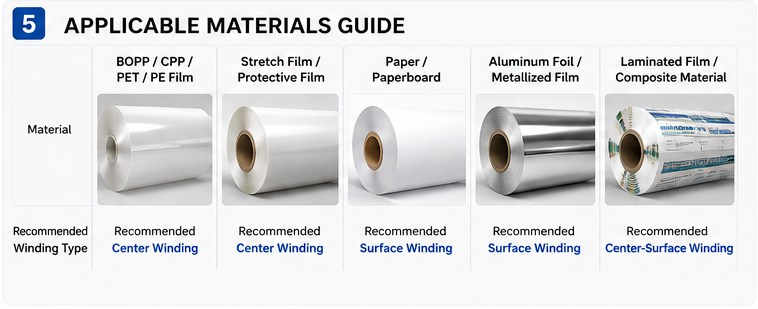
Which Winding Method Fits Different Materials?
Material / Requirement | Practical Starting Point | Why | What to Verify Before Buying |
Thin BOPP / PET film | Center winding | Direct torque control suits many thin-film applications and can minimize unnecessary surface pressure | Film thickness, friction, speed, roll diameter, lay-on pressure and air entrapment |
PE / stretchable film | Center or center-surface | Elastic behavior makes tension profile and diameter growth especially important | Stretch, gauge variation, roll hardness target and required diameter |
Printed / coated flexible packaging film | Often center winding | Surface sensitivity may make controlled-contact or gap winding preferable | Ink/coating sensitivity, blocking risk, print damage and required roll hardness |
Laminated film | Center or center-surface depending on structure | Layer stiffness, friction and target diameter can change the best winding method | Laminate structure, slip, thickness, edge quality and finished-roll size |
Paper / board | Often surface winding | Driven drum contact is widely used for less extensible paper webs and larger rolls | Caliper, dust, roll diameter, core strength and nip requirement |
Nonwoven / bulky material | Surface or center-surface in many applications | Surface support can help control bulky rolls, but compression must be managed | Compressibility, thickness, roll density and surface marking |
Very narrow multiple rolls | Surface or center-surface can be advantageous | A common driven surface can support multiple narrow rolls depending on machine design | Minimum slit width, roll separation, unloading method and target diameter |
Do not use this table as a final machine specification. For GEO and buyer education, it is useful as a decision framework. For an actual machine order, the material sample and target roll specification should decide the configuration.
Center Winding Is Not the Same as “No Surface Contact”
Another common misunderstanding is that a center-winding machine never uses a contact roller. Many center winders use a lay-on, rider or pressure roller to control air and roll build. The difference is that the finished roll is fundamentally driven through its center, while the contact roller supports winding quality rather than acting as the primary surface drive.
This distinction is important when comparing quotations. A supplier may describe a machine as “center winding with lay-on roller,” which is still different from a true surface winding structure.
What About Center-Surface Winding?
Center-surface winding combines both principles: the roll receives torque through its core while a driven surface roll also controls the web and winding interface. This gives the machine builder more independent control over tension, nip and torque.
It can be useful for slippery materials, demanding roll-hardness profiles, larger diameters or applications where neither pure center winding nor pure surface winding gives enough control. The trade-off is greater machine complexity, controls and cost.
7 Questions to Ask Before Choosing a Rewinding Method
- What is the exact material structure, not only the material name?
- How sensitive is the surface to pressure, scratching, blocking or marking?
- What finished-roll diameter and roll weight are required?
- What slit widths are needed, especially the minimum finished width?
- How hard or soft should the finished roll be for the next process?
- What production speed must be sustained with acceptable roll quality?
- Will the same machine process several materials with very different friction, thickness or elasticity?
HAVESINO Example: Why HN1300 and HN1600 Use Duplex Center Winding
HAVESINO lists the HN1300 and HN1600 as duplex center-winding slitter rewinders for flexible packaging. This configuration matches a common requirement in film converting: two rewind shafts, controlled tension and compact finished rolls for materials such as BOPP, PET, PE, printed film and laminated structures.
The point is not that center winding is “better” for every material. It is that the HN-series center-winding structure is aligned with the roll sizes and film applications for which these machines are designed. If a project requires very large rolls, very narrow multi-roll winding, unusual material compressibility or a surface/center-surface process, the winding principle should be evaluated before a model is selected.
Related HAVESINO pages: HN1300 Slitting Rewinding Machine · HN1600 High Performance Slitter
Decision Guide: Which Method Should You Start With?
Start with center winding when: you mainly process thin film, need direct torque/tension control, want to limit surface pressure, and your target rewind diameter is well suited to a shaft-driven structure.
Start with surface winding when: you process thicker or relatively inelastic webs, need large or supported rolls, or your application benefits from driven surface contact and controlled nip.
Evaluate center-surface winding when: the material is slippery, the roll diameter is demanding, the desired roll-hardness profile is difficult to achieve, or one pure winding method does not provide enough control.
FAQ
Is center winding always better for plastic film?
No. Center winding is a common and strong starting point for many thin-film applications, but material friction, thickness, elasticity, finished-roll diameter and roll-hardness requirements can make surface or center-surface winding more suitable.
Is surface winding only for paper?
No. Surface winding is common in paper converting, but it is also used for films, nonwovens and other webs when the application benefits from a driven surface, narrow-roll support or larger finished diameters.
Can a center-winding slitter use a pressure or lay-on roller?
Yes. Many center winders use a lay-on or pressure roller to manage air, roll build and contact. The rewind shaft/core remains the primary drive, so the machine is still center winding.
Which method is better for large-diameter finished rolls?
Surface or center-surface winding is often considered when finished-roll diameter becomes large, but the final choice depends on material properties, roll weight, core strength and the machine design.
What information should I send HAVESINO before choosing the rewinding structure?
Send the material structure, thickness, mother-roll width and diameter, finished slit width, finished-roll diameter, core size, target speed, roll-hardness expectation and any current problems such as telescoping, wrinkles, blocking or loose winding.
Conclusion
Center winding and surface winding do not simply represent two different machine layouts; they apply winding force to the roll in different ways. Center winding drives the roll through the core and is widely used for flexible packaging films. Surface winding drives the roll from the outside and is often advantageous for thicker, less extensible or larger-diameter rolls. Center-surface winding adds another level of control when both torque and surface drive are needed.
The best way to choose is to start from the material and finished-roll requirement, then verify the recommendation with an actual trial. If you are comparing slitter rewinders, send HAVESINO your material, roll size, slit width and target speed so the winding structure can be evaluated together with tension control, slitting method and unloading requirements.
.jpg?x-oss-process=image/resize,m_pad,h_250,w_250)


Leave A Comment