

 English
 German
 French
 Russian
 Spanish
 Japanese
 Korean
 Portuguese
 Ukrainian
 Arabic
 Italian
 Afrikaans
 Albanian
 Armenian
 Azerbaijani
 Basque
Direct answer: A web guiding system keeps a moving film, foil, paper, labelstock or other web aligned to a defined edge, line or center position as it travels through a slitter rewinder. EPC — Edge Position Control — detects lateral movement and commands a guiding actuator to correct the web before misalignment reaches the slitting or rewinding section. Accurate guiding helps maintain slit position, cleaner roll edges and more stable rewinding, but it does not replace correct tension, roller alignment or web-path setup.
For buyers, the practical question is not simply whether a machine “has EPC.” The more useful questions are: Where is the guiding point? What does the sensor detect? How quickly and smoothly does the system respond? Is the sensor suitable for the actual material surface?
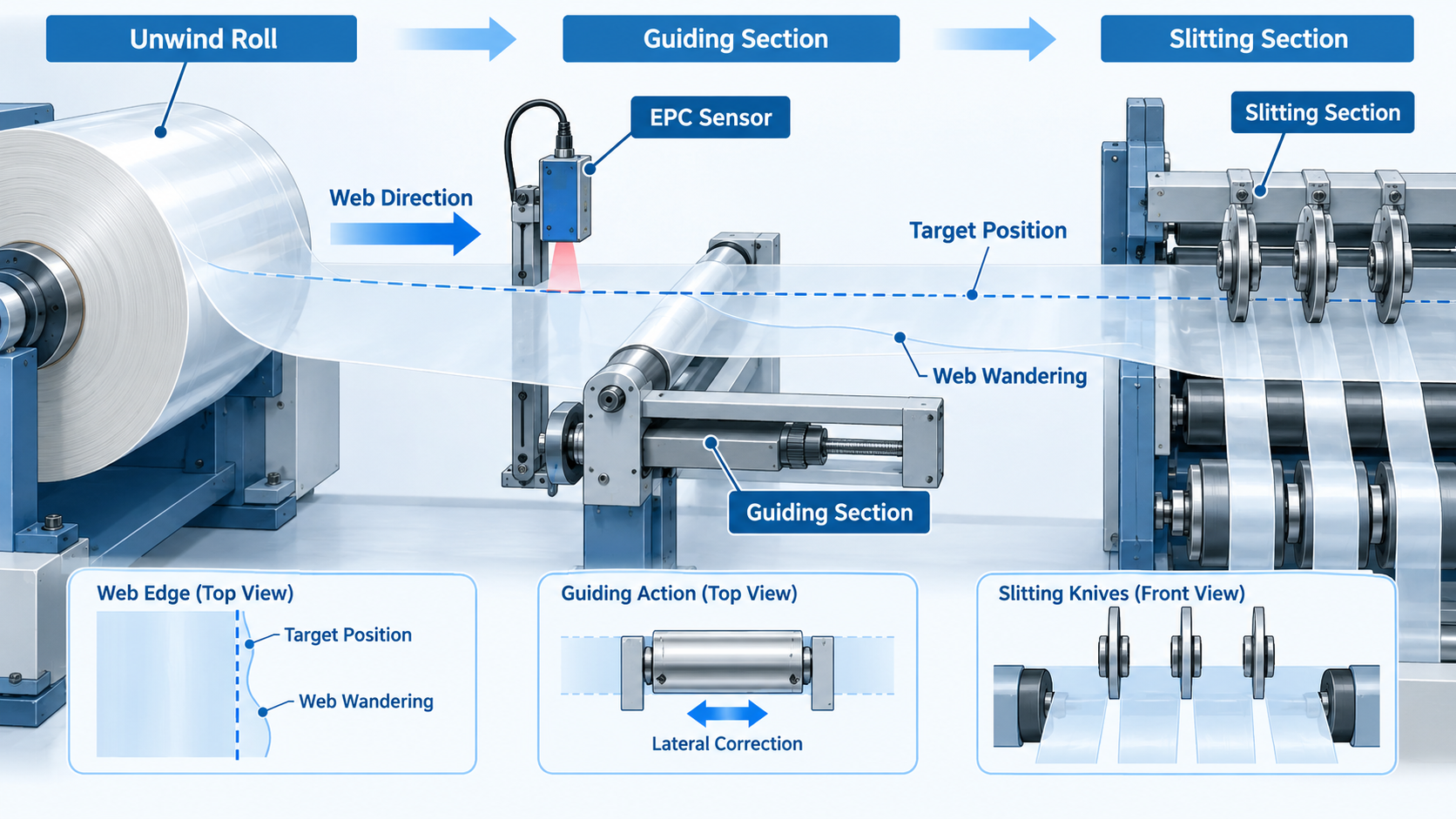
Web Guiding at a Glance
Question | Practical Answer | Why It Matters |
What does EPC control? | Lateral web position, usually by following an edge, printed line/mark or center reference. | Helps keep the web entering the slitting and rewinding sections consistently. |
Where should it act? | At a guiding section positioned so correction happens before the critical process point. | Correction that happens too late may not protect slit accuracy or roll alignment. |
What can EPC not fix? | Severe tension instability, misaligned rollers, damaged rolls, poor splicing or a mechanically unstable web path. | A guide can correct position, but it cannot solve every web-handling problem. |
Is one sensor suitable for every material? | No. Optical, ultrasonic and other sensor methods behave differently with transparent, reflective, printed or irregular materials. | Sensor choice should match the real substrate and reference to be tracked. |
What Is Web Guiding in a Slitter Rewinder?
A roll-to-roll web can move sideways while it is being unwound, accelerated, slit and rewound. Small lateral errors may come from the incoming roll, tension variation, roller geometry, splices, material curl, air movement or the material itself. A web guiding system monitors this lateral position and makes controlled corrections so the web follows the required path.
In a slitter rewinder, the guiding system is especially important because the web position upstream of the knives affects where the material enters the slitting section. After slitting, stable web handling also supports more consistent finished-roll edges and roll build.
How an EPC Web Guiding System Works
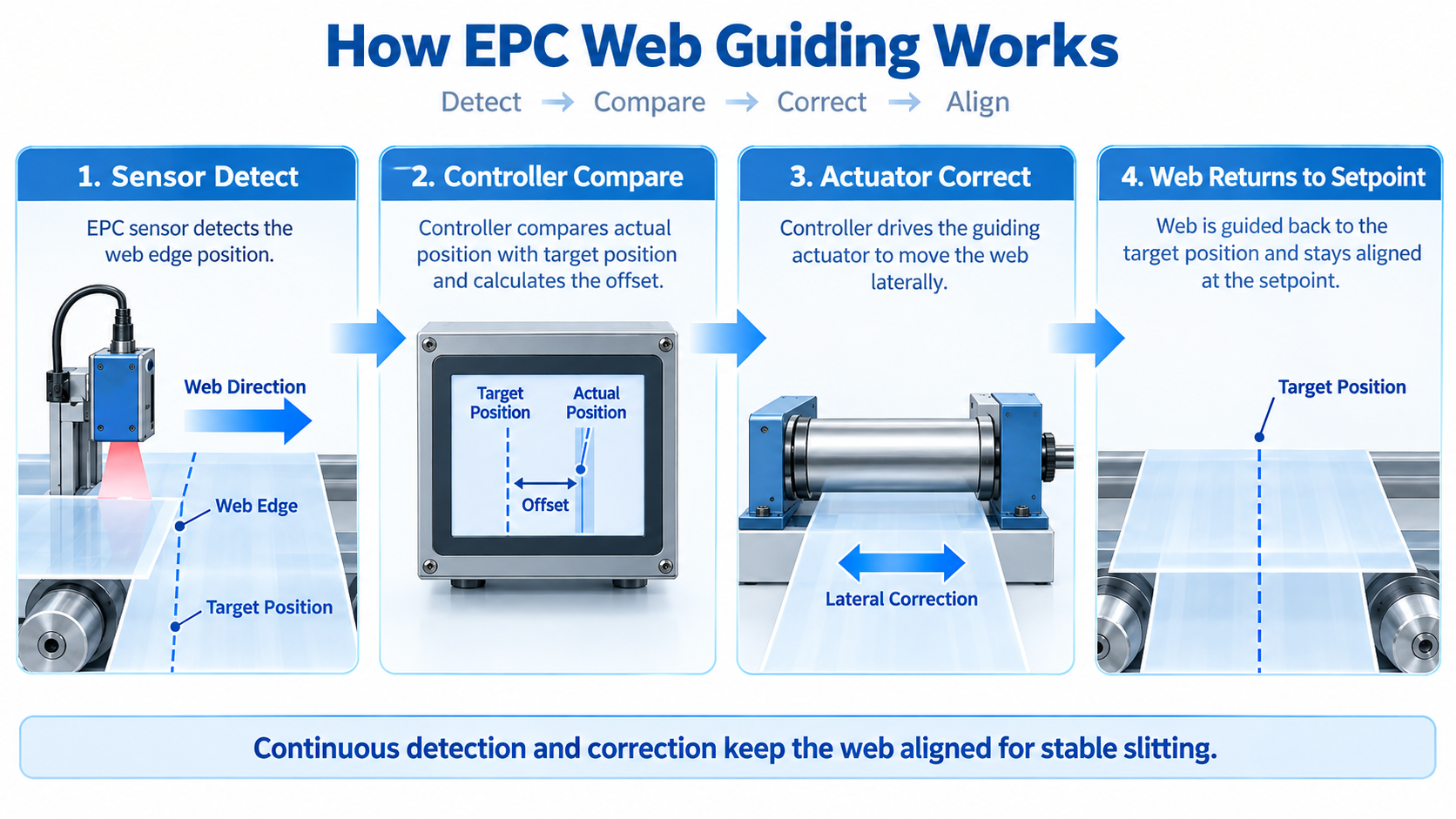
1. Detect — A sensor continuously reads the web edge, a printed reference line/mark, or another defined position.
2. Compare — The controller compares the detected position with the target setpoint.
3. Correct — If the web moves laterally, the controller sends a command to a guiding actuator or moving frame.
4. Stabilize — The system returns the web toward the reference position without creating excessive oscillation or abrupt movement.
The best guide is not the one that moves most aggressively. A well-tuned system should correct the web smoothly and only as much as needed. Over-correction can create hunting, repeated side-to-side motion or unstable entry into the slitting section.
Why Does the Web Wander Side to Side?
When a customer sees web wandering, EPC is often blamed first. In practice, the guide may only be responding to another problem. Common causes include:
- Parent roll edges are not straight or the roll is wound unevenly.
- Unwind tension changes during acceleration, deceleration or diameter reduction.
- Rollers, shafts or guide components are not mechanically aligned.
- The splice is skewed or has uneven thickness across the web.
- Thin or stretchable film responds strongly to small tension differences.
- The material has curl, camber or uneven stiffness.
- The sensor reference is unstable because the edge is transparent, reflective, irregular or printed inconsistently.
- The EPC sensitivity or correction gain is set too aggressively or too slowly.
Edge Sensor, Line Sensor or Ultrasonic Guide: Which One Is Suitable?
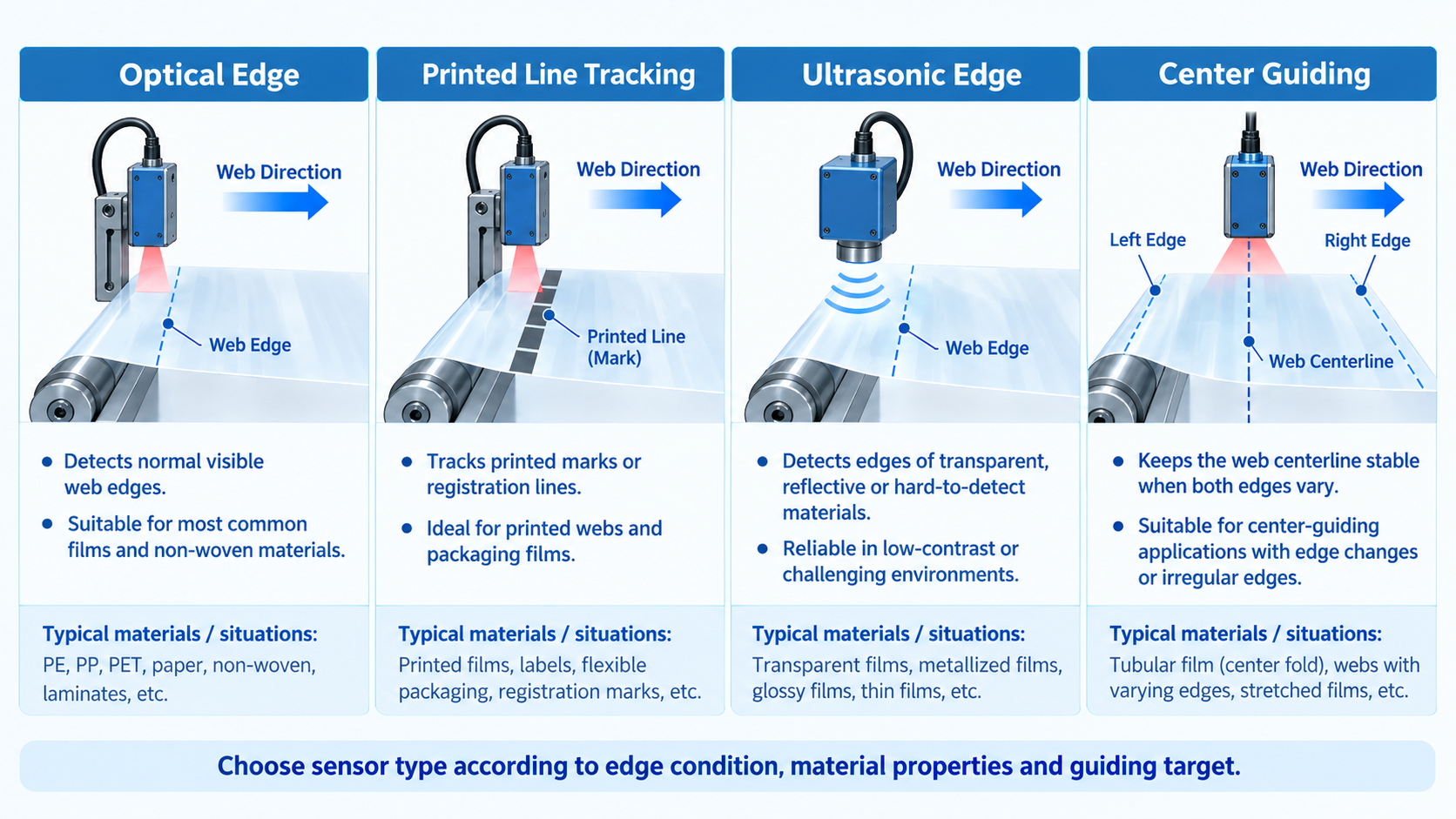
Sensor selection matters because different materials create different detection challenges. The supplier should match the sensing method to the reference that can be detected reliably on your actual web.
Guiding Reference | Typical Method | Useful For | Main Check |
Material edge | Optical / photoelectric edge sensor | Many opaque or clearly detectable film, paper and label webs | Can the sensor consistently distinguish the web edge from background? |
Printed line or registration mark | Line / mark tracking sensor | Printed webs where the customer wants to follow a printed reference instead of the physical edge | Is the line contrast and print quality stable through the full roll? |
Transparent or highly reflective edge | Ultrasonic edge guiding can be useful in some applications | Transparent, shiny or reflective webs that can challenge optical detection | Test the real material; do not select only from a brochure description. |
Center position | Center guiding using two-edge or equivalent detection | Applications where the web must stay centered rather than follow one edge | Are both edges sufficiently stable and detectable? |
HAVESINO example: the HN1300R product page specifies an EPC web guide system that automatically tracks the film edge or marking line. For reflective foil applications, HAVESINO also lists ultrasonic EPC on selected hot-stamping-foil equipment to reduce the influence of light reflection. The exact sensor type should therefore be confirmed by material and application rather than standardized for every machine.
Why EPC Accuracy Matters Before Slitting
The slitting knives do not decide where the incoming web enters the machine. If the whole web shifts sideways before the knife section, even a precisely positioned knife set can produce an unstable relationship between the material edge and the slit pattern.
- Keeps the web in a repeatable lateral position before the knife section.
- Helps maintain consistent trim-edge width and reduces unnecessary side-trim variation.
- Supports cleaner, more uniform finished-roll edges.
- Reduces operator intervention when the parent roll has small lateral movement.
- Helps printed or pre-processed webs maintain a stable relationship between printed features and the slitting path when the guiding reference is configured correctly.
Important limitation: EPC accuracy does not guarantee slit-width accuracy by itself. Knife positioning, machine frame stability, web tension, roller alignment and the mechanical slitting system still determine the final result.
Web Guiding and Tension Control Must Work Together
Web guiding controls lateral position; tension control manages the force acting along the web direction. They solve different problems, but they interact. A very loose web may not respond predictably to lateral correction, while an over-tensioned or unevenly tensioned web can exaggerate tracking problems.
For this reason, a buyer should evaluate web guiding together with the tension system rather than as an isolated accessory. See HAVESINO’s article on Why Tension Control Matters in Film Slitting and Rewinding for the relationship between web stability, slitting and roll quality.
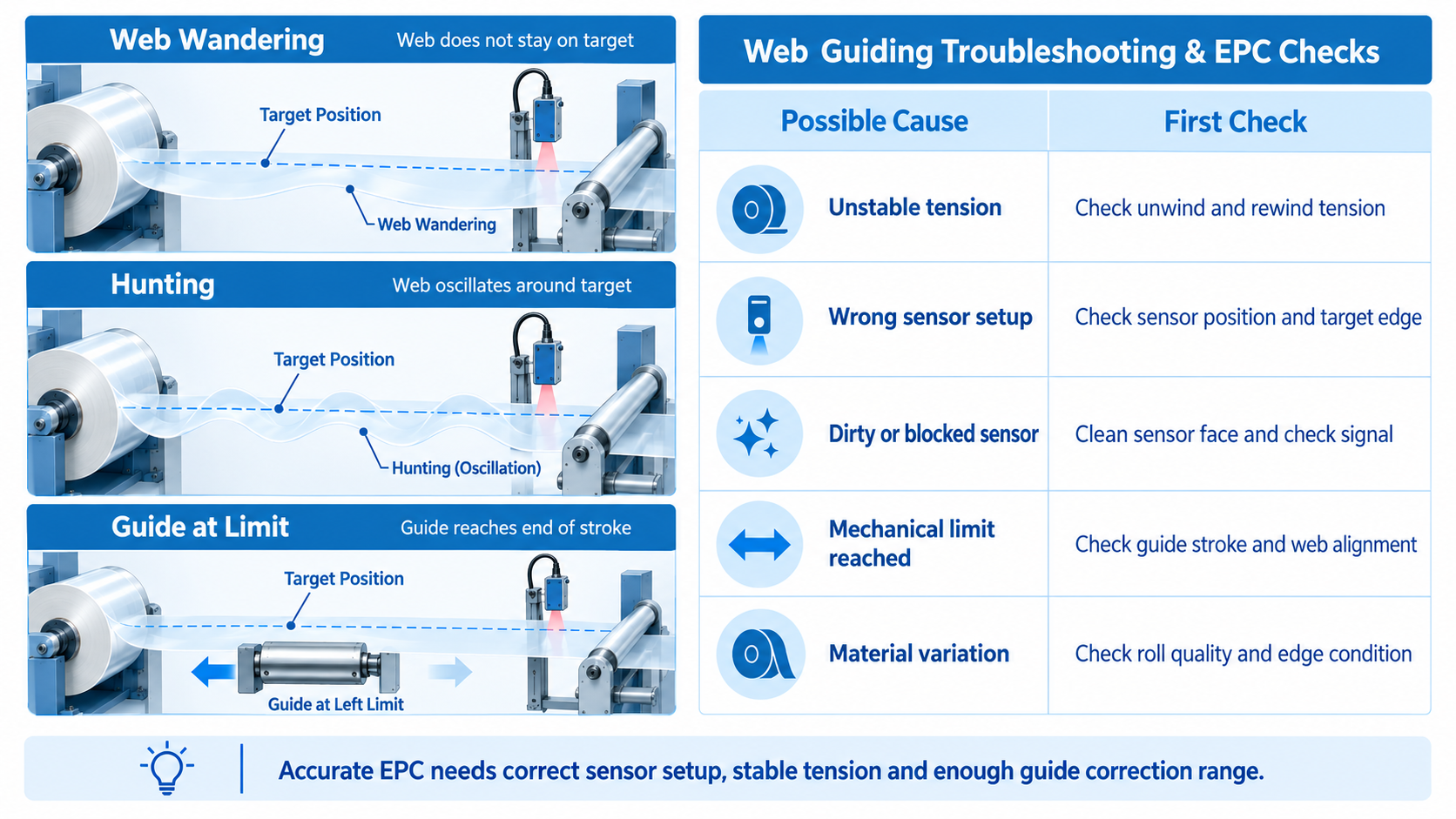
Web Keeps Wandering Even with EPC: What Should You Check?
Symptom | Possible Cause | First Check |
Web oscillates left-right repeatedly | Gain/sensitivity too aggressive, unstable reference, web too loose | Reduce over-correction, inspect sensor signal and tension stability |
Guide reaches one side of travel and stays there | Parent roll or web path is mechanically biased | Check roll loading, roller alignment and incoming roll condition |
Tracking becomes unstable only at higher speed | Response tuning, tension change, vibration or sensor signal quality | Compare low-speed vs production-speed behavior and review tension trend |
Sensor works on one material but not another | Detection principle does not suit transparency, reflection or print contrast | Test a sensor/reference appropriate to the actual material |
Slit edges still look uneven although EPC is stable | Knife setup, roller alignment or rewinding condition may be the real cause | Separate guiding accuracy from cutting and winding diagnostics |
7 Things Buyers Should Check on a Web Guiding System
- What does the machine guide to: material edge, printed line, center, or another reference?
- Where is the guiding sensor located relative to the slitting knives?
- What part of the machine physically moves to correct the web?
- Is the sensor suitable for transparent, reflective, printed or irregular material if you process those webs?
- Can the operator adjust sensitivity / response without making the system unstable?
- How much lateral correction travel is available, and what happens when the incoming roll is badly misaligned?
- Can the supplier demonstrate the system using your actual material at realistic working speed?
HAVESINO Application Example
HAVESINO uses EPC web guiding on multiple roll-to-roll machines, but the implementation is application-specific. For example, the HN1300R High-Speed and Smart Rewinding Machine is specified with an EPC web guide system that tracks the film edge or marking line automatically to support stable material running.
For hot stamping foil, the HN800 Hot Stamping Foil Slitter Rewinder is listed with ultrasonic edge guiding on the unwind side, which is intended to avoid problems caused by shiny material reflecting light back to an optical sensor.
The practical lesson is simple: choose the guiding method around the material and the reference you need to follow. A web guide should be tested as part of the full web-handling system, together with tension control, slitting and rewinding.
FAQ
What does EPC mean on a slitting machine?
EPC commonly refers to Edge Position Control. It uses a sensor, controller and correction mechanism to keep the moving web aligned to a target lateral position.
Can EPC fix an uneven jumbo roll?
It can compensate for some lateral movement, but it cannot rebuild a badly wound parent roll or correct severe mechanical misalignment. The incoming roll and machine geometry still matter.
Is ultrasonic guiding always better than optical guiding?
No. Ultrasonic guiding can be useful for certain transparent or reflective materials, while optical or line-tracking sensors may be better for other applications. The correct choice depends on the material and the reference to be detected.
Should the EPC be before or after the slitting knives?
For controlling where the parent web enters the slitting section, guiding must act before the critical cutting point. Machines can also use additional guiding functions elsewhere depending on the process layout.
Does better EPC automatically mean better finished rolls?
Not by itself. Finished-roll quality also depends on tension control, knife setup, roller alignment, rewinding torque/nip conditions and the material itself.
Conclusion
Web guiding is one of the basic control systems that determines whether a slitter rewinder can keep the web entering the process consistently. A well-selected EPC system detects lateral movement, corrects the web smoothly and reduces unnecessary operator intervention.
However, the value of EPC comes from correct application, not from the name of the component. Buyers should evaluate the sensor reference, material compatibility, guiding position, response behavior and integration with tension control. If the material is transparent, reflective, printed, stretchable or difficult to track, the best approach is to test the real roll before finalizing the machine configuration.
If you are choosing a slitter rewinder, send HAVESINO your material type, thickness, jumbo-roll width and diameter, finished slit width, target speed and any existing tracking problem. Contact HAVESINO to discuss a suitable web-guiding and slitting configuration.
.jpg?x-oss-process=image/resize,m_pad,h_250,w_250)


Leave A Comment