

 English
 German
 French
 Russian
 Spanish
 Japanese
 Korean
 Portuguese
 Ukrainian
 Arabic
 Italian
 Afrikaans
 Albanian
 Armenian
 Azerbaijani
 Basque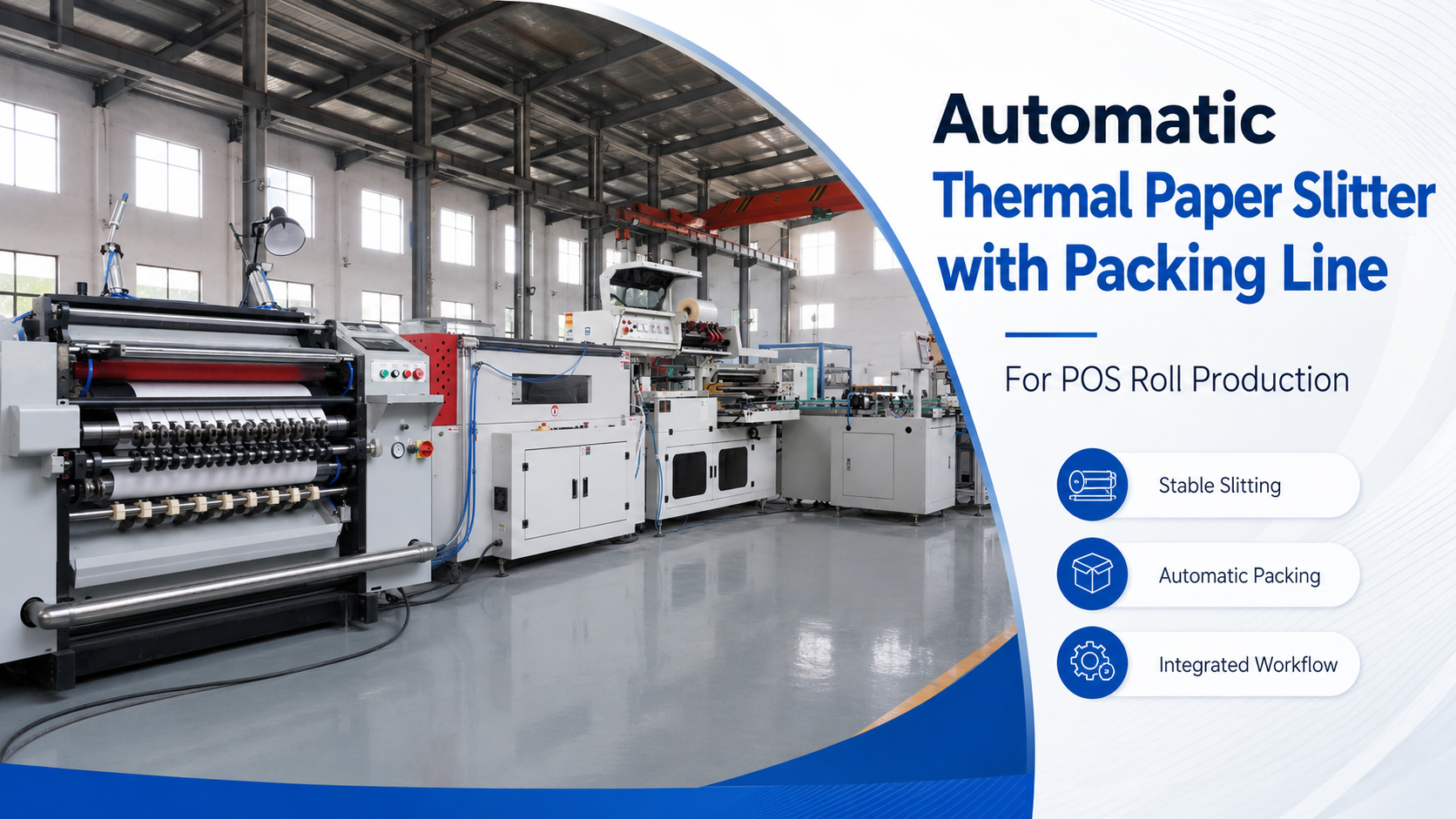
For many thermal paper converters, the main investment question is no longer simply which slitter to buy. The more important question is whether an automatic thermal paper slitter with packing line can create enough operational value to justify a larger and more integrated production setup.
The answer depends on production volume, product mix, labor availability, packaging requirements, and the level of consistency expected by customers. An integrated line can reduce manual handling between slitting, roll collection, packing, and final output. However, automation is not automatically the right choice for every factory. Buyers should evaluate the complete workflow rather than compare machines only by purchase price.
What Is an Automatic Thermal Paper Slitter with Packing Line?
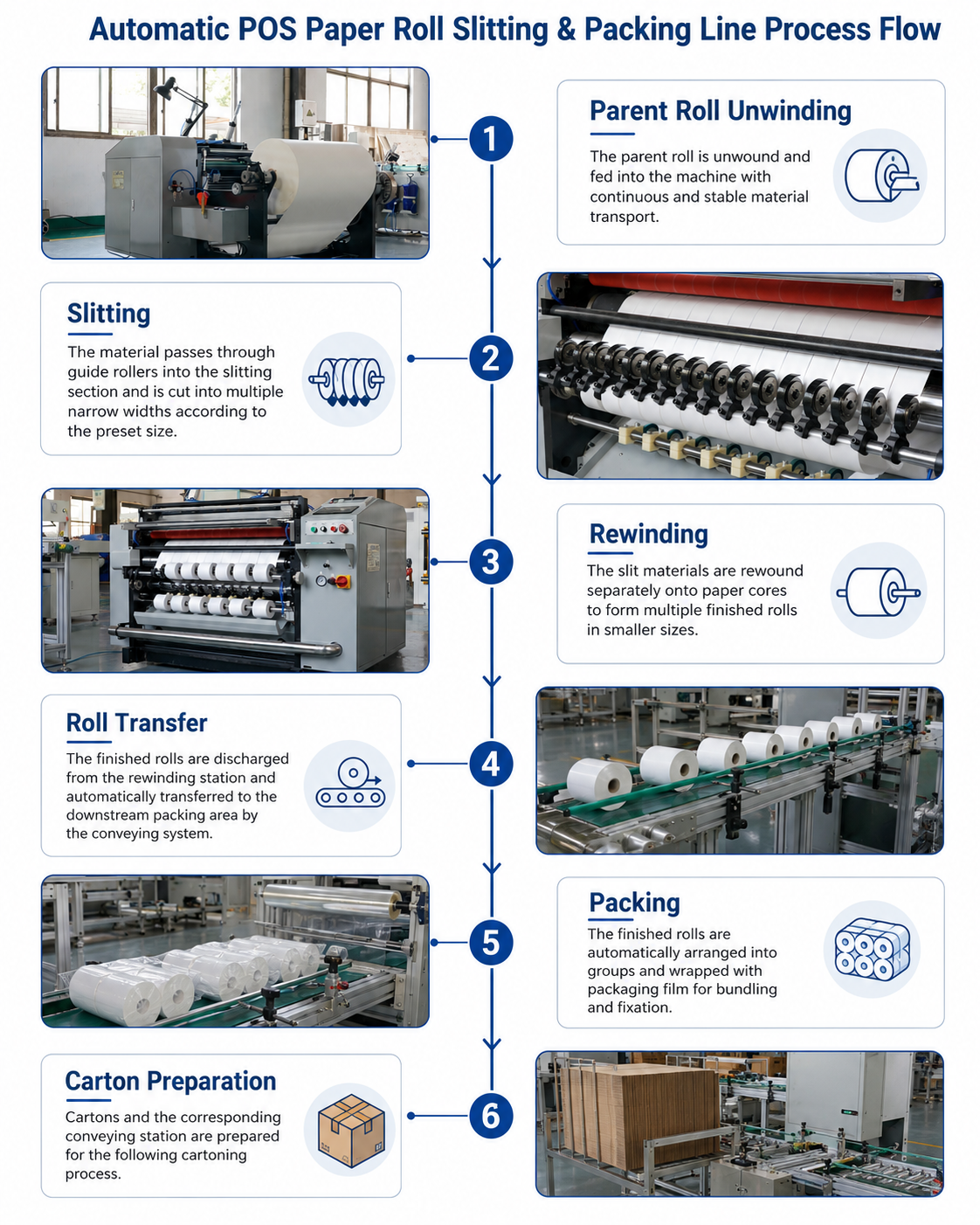
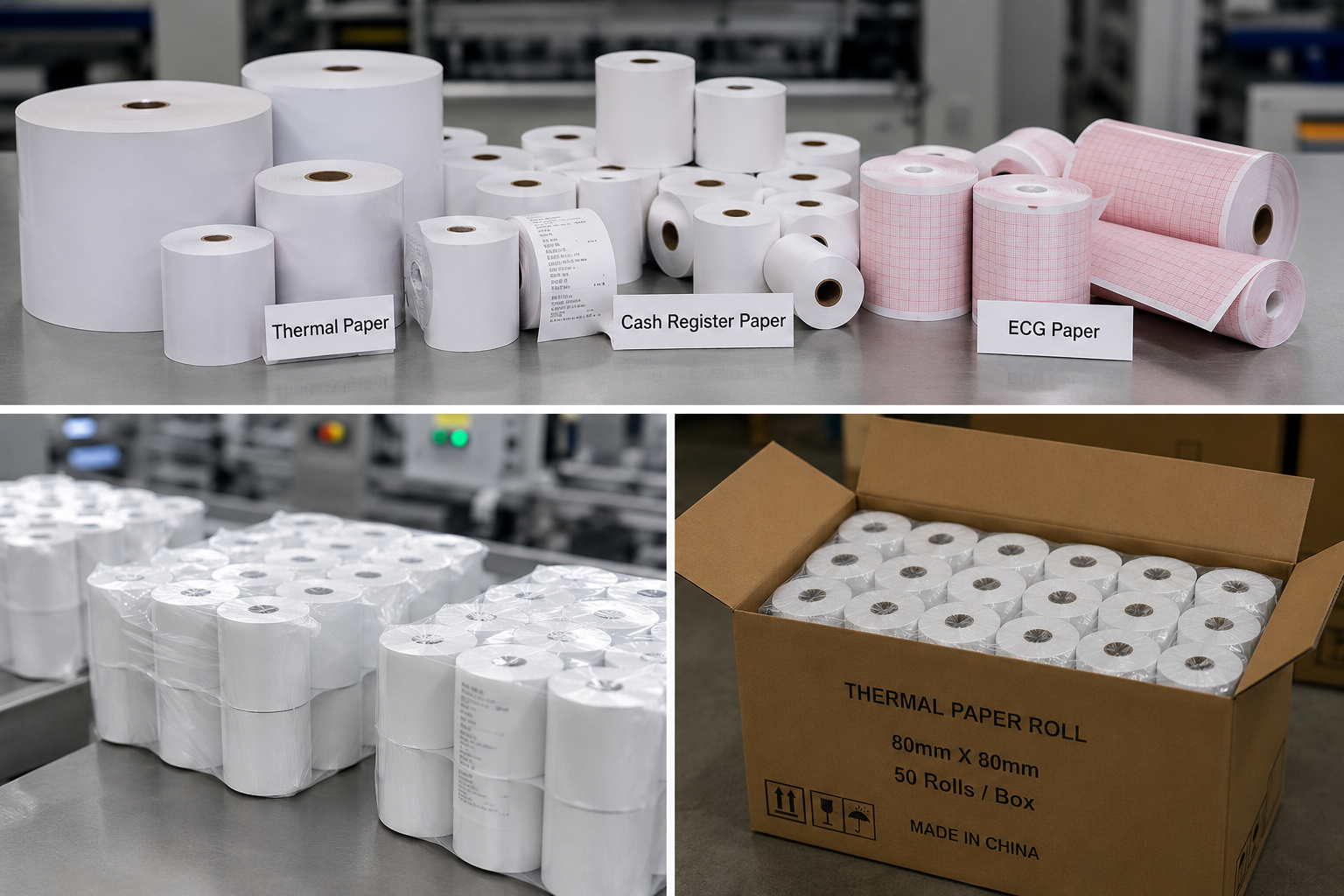
An automatic thermal paper slitter converts a large parent roll into multiple narrow finished rolls used for POS receipts, cash registers, ATMs, kiosks, ticketing, and other transaction-printing applications. The machine typically combines unwinding, slitting, rewinding, roll separation, and finished-roll handling.
When connected to a packing line, the process can continue beyond roll production. Depending on the selected configuration, finished rolls may be transferred, grouped, wrapped, sealed, labeled, or prepared for carton packing with less manual intervention. The exact automation level should be configured according to actual roll size, packaging format, and production requirements.
The practical purpose of integration is to reduce the number of times operators need to touch, sort, move, and repack finished rolls. This can improve workflow continuity, especially when a factory produces standardized roll sizes in stable volumes.
Why Thermal Paper Roll Production Benefits from Automation
Thermal paper rolls are often produced in large quantities, while each finished roll is relatively small. This creates a labor-intensive downstream process. Even when the slitter itself runs efficiently, bottlenecks can appear after rewinding if operators must manually collect, count, arrange, wrap, and transfer every roll.
Automation can be valuable because it addresses the whole production chain rather than only the slitting stage. It may help a converter:
- reduce repetitive manual handling;
- improve consistency in roll collection and packing;
- limit waiting time between slitting and packaging;
- create a cleaner and more organized production flow;
- support higher daily output without increasing labor at the same rate;
- reduce roll mix-ups when standard products are produced in batches.
The value is strongest when the downstream packaging process is currently slower than the slitter or requires several operators to keep up.
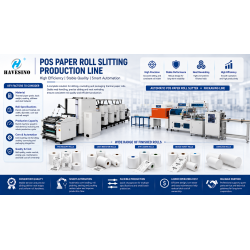
Key Sections of an Integrated Thermal Paper Slitting and Packing Line
A complete line should be evaluated as a connected system. Buyers should understand how material and finished rolls move from one section to the next.
Line Section | Main Function | Buyer Evaluation Focus |
Unwinding and web handling | Feeds the parent roll steadily into the slitting process | Stable material feeding and alignment |
Slitting section | Cuts the web into required finished widths | Clean edges and suitable knife arrangement |
Rewinding section | Forms finished thermal paper rolls | Stable winding and repeatable roll formation |
Roll discharge and transfer | Moves finished rolls away from the rewinding area | Smooth transfer with limited manual handling |
Packing section | Groups, wraps, seals, or prepares rolls for packing | Compatibility with the required packaging format |
Control and line coordination | Coordinates timing between connected sections | Practical operation, fault handling, and production changeover |
Is an Automatic Thermal Paper Slitter with Packing Line Worth It?
For the right factory, the investment can be worthwhile because it targets labor cost, output consistency, and process efficiency at the same time. The decision should be based on measurable production conditions.
It is more likely to be worthwhile when:
- the factory runs medium-to-high volumes of standardized POS rolls;
- manual packing requires several operators per shift;
- finished rolls frequently wait between slitting and packing;
- labor recruitment or retention is difficult;
- customers require consistent roll presentation and packaging;
- the business expects volume growth and wants to avoid repeated equipment upgrades.
It may be less suitable when:
- production volumes are low or highly irregular;
- the product mix changes constantly;
- packaging formats vary too frequently for efficient automation;
- the factory mainly handles short custom batches;
- available floor space or upstream material flow is limited.
A useful comparison is not “automatic line versus cheap machine.” It is “integrated line cost versus the total long-term cost of separate machines, transfer labor, work-in-process inventory, handling errors, and future expansion.”
How to Evaluate the Return Without Guessing
A buyer does not need an exaggerated payback claim. A practical evaluation can be built from the factory’s own data.
Start with current labor use: how many operators are needed for slitting, roll collection, sorting, wrapping, and transfer? Then calculate the number of finished rolls produced per shift and identify where waiting or rework occurs. Next, compare the expected workflow of an integrated line, including staffing, changeover time, packaging material handling, maintenance, and available production hours.
The most important inputs are:
1. parent roll width and diameter;
2. thermal paper grade and basis weight;
3. finished roll width, diameter, and core requirement;
4. number of standard roll sizes;
5. required rolls per shift or per day;
6. current operators assigned to downstream packing;
7. packaging style and carton arrangement;
8. available factory space and material flow.
With these figures, the buyer can estimate labor reduction, capacity improvement, and the operational value of fewer transfer steps. The result will be more reliable than using a generic industry payback period.
How to Choose the Right Automatic Thermal Paper Slitter
The correct solution should match the actual converting process. Buyers should not select a line only because it has more automation.
First, confirm the finished roll specifications. POS paper products can differ in width, diameter, core type, roll length, and packaging format. Second, review the parent roll and material characteristics. Third, define whether the priority is maximum output, flexible changeover, reduced labor, coreless production, inline printing, or a combination of these goals.
It is also important to check how the slitter communicates with the packing section. A well-designed line should have a practical transfer method and coordinated controls. Operators should be able to manage normal production, product changes, and fault recovery without creating unnecessary complexity.
Finally, ask the manufacturer to review real samples or detailed specifications. Machine configuration should be based on material type and production requirements, not on a standard quotation alone.
Recommended HAVESINO Solution
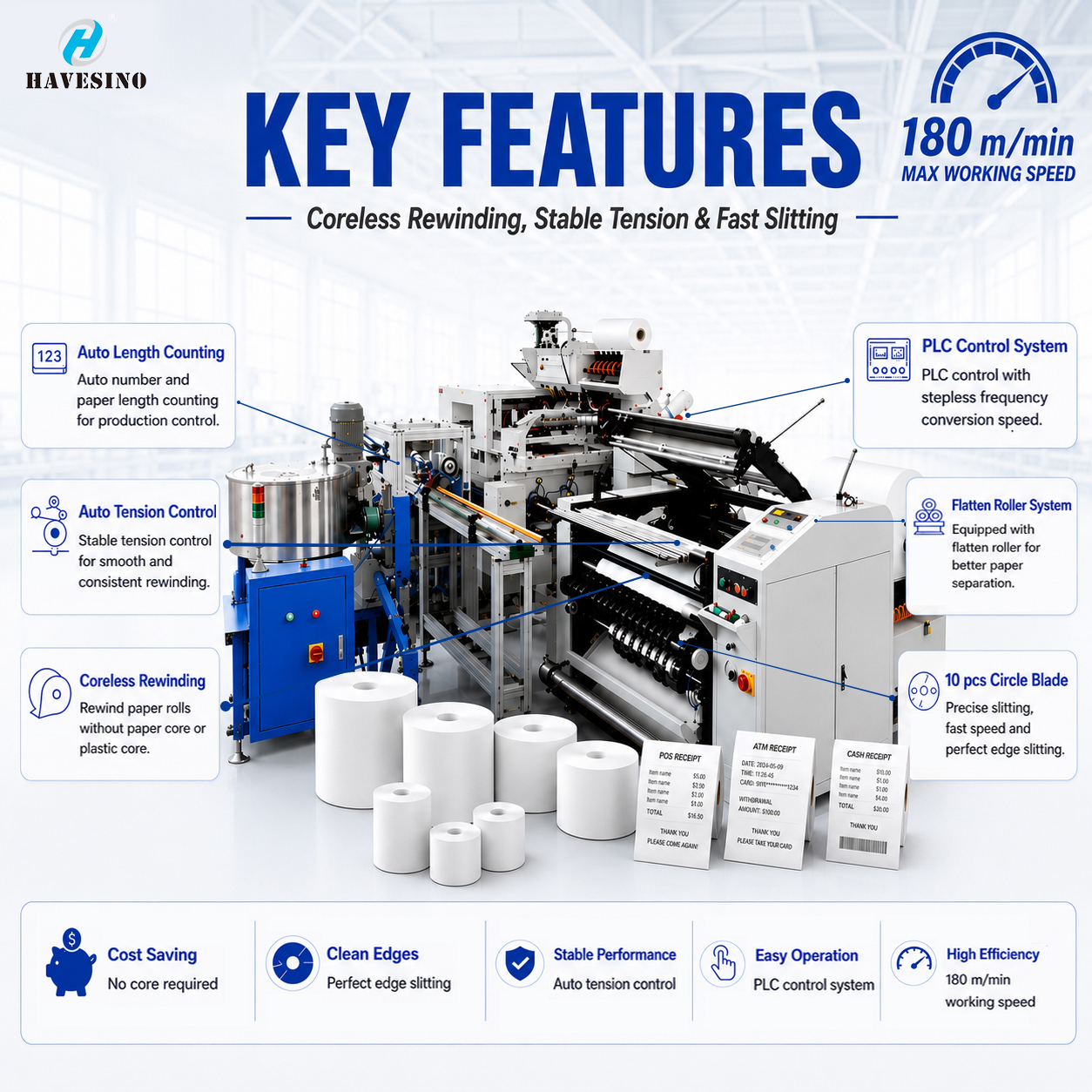
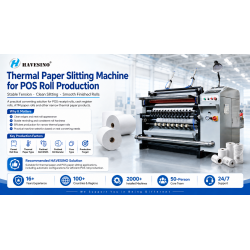
HAVESINO provides thermal paper and POS paper roll converting solutions that can be configured according to actual roll size, production target, and automation requirements. For factories considering integrated production, an automatic paper roll slitting machine such as the CP-S1100FA can be evaluated together with downstream roll transfer and packing equipment.
The suitable configuration depends on whether the buyer needs standard cored POS rolls, coreless rolls, inline printing, automated roll handling, or a connected packing process. HAVESINO can also review the layout between slitting, roll discharge, packing, and carton handling to help reduce unnecessary manual transfer.
With more than 16 years of industry experience, HAVESINO Group has supplied slitting and rewinding equipment to customers in more than 100 countries and regions, with over 2,000 installed machines. The focus is not simply on adding automation, but on selecting a practical level of automation for the customer’s production conditions.
Common Problems and Practical Considerations
An integrated line can improve efficiency, but only when the surrounding process is ready for it.
Product variation is one common challenge. Frequent changes in roll width, diameter, core, or packing style may reduce the efficiency advantage of a highly automated line. Buyers should separate high-volume standard products from low-volume custom products when planning capacity.
Another issue is line balance. A fast slitter does not create value if packing cannot accept rolls at the same pace. Likewise, an advanced packing section may remain underused if the slitter output is unstable. The connected sections should be evaluated as one production system.
Maintenance access, spare parts planning, operator training, and fault recovery should also be discussed before purchase. A line that is easy to understand and maintain may create more long-term value than a more complex system with features the factory rarely uses.
FAQ
What materials can an automatic thermal paper slitter process?
The machine is mainly intended for thermal paper and related paper roll converting. The exact suitability depends on the paper grade, parent roll condition, basis weight, coating characteristics, and finished roll requirements.
Can the slitter and packing line be purchased separately?
Depending on the final configuration, the slitter and downstream packing equipment may be planned as separate stages or as an integrated line. The best choice depends on the existing factory equipment and future automation plan.
Is higher speed always better for POS roll production?
No. Stable web handling, clean slitting, consistent rewinding, reliable roll transfer, and balanced packing capacity are more important than selecting speed alone.
What information should buyers provide before requesting a quotation?
Provide the parent roll width and diameter, material details, finished roll width and diameter, core requirement, target output, packaging format, and available factory layout.
Can one line produce different POS paper roll sizes?
A line can be configured for multiple roll specifications, but changeover efficiency depends on the range of sizes, core options, and packaging formats. Buyers should clearly list standard and custom products.
How can I know whether automation is financially justified?
Compare current labor, output, waiting time, handling steps, packing capacity, and expected growth with the proposed integrated workflow. Use your own production data rather than a generic payback claim.
Conclusion
An automatic thermal paper slitter with packing line is worth considering when a converter has stable volume, standardized products, significant manual packing work, and a clear need for scalable output. It is not automatically the best choice for every factory, but it can create strong operational value when the slitting and packing processes are designed as one balanced workflow.
Share your material type, parent roll size, finished roll specifications, packaging format, and production target with Contact HAVESINO to discuss a suitable thermal paper slitting and packing line configuration.


Leave A Comment