

 English
 German
 French
 Russian
 Spanish
 Japanese
 Korean
 Portuguese
 Ukrainian
 Arabic
 Italian
 Afrikaans
 Albanian
 Armenian
 Azerbaijani
 Basque
What Tension Control System Is Recommended for Slitting Self-Adhesive Labels to Avoid Label Shifting?
\n \nSelf-adhesive label converting is among the most demanding processes in the flexible packaging and label industry. A self-adhesive label stock is a three-layer composite — face material, adhesive, and silicone-coated release liner — which makes it inherently sensitive to tension variations. When tension is not precisely controlled during slitting, labels shift laterally or longitudinally on the liner, leading to die-cutting misalignment, telescoped rolls, and costly rejects. For production engineers and plant managers, the question of which tension control system to use is therefore a critical investment decision.
\n \nWhy Label Shifting Happens
\nLabel shifting occurs when the forces acting on the web during slitting are unbalanced or variable. The most common root causes include:
\n- \n
- Inconsistent unwind tension from the jumbo roll, especially as roll diameter decreases during operation. \n
- Lateral web wandering due to the absence of effective automatic deviation correction. \n
- Uneven rewind tension across the web width, which deforms the label matrix. \n
- Disturbances caused by the waste matrix being peeled away unevenly during the die-cutting and slitting process. \n
- Speed variations that induce sudden tension spikes, particularly at machine start-up and reel changeover. \n
None of these issues can be fully resolved by manual tension adjustment alone. A coordinated, automated tension control system is required.
\n \n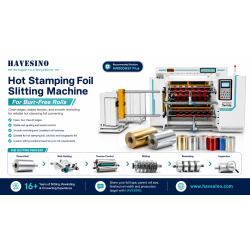
.png?x-oss-process=image/resize,m_pad,h_250,w_250)


Leave A Comment